
Fax, telegrams and patience
When I first started working at NAJ International, one of our main tools for communication in recruitment was the fax machine. We used it to send documents, confirmations and information between clients, candidates and consultants.
There was no email yet, so exchanging documents required patience. Every message had to be prepared carefully. Making a correction was not a matter of a quick click. You had to change the document, print it again and send it once more.
We also used telegrams to contact candidates. They had to be very short because you paid for every word. Today, this may sound like a curiosity from another era. At the time, it was a real form of fast communication.
It required discipline. You could not send a long message, explain everything in several paragraphs or follow up an hour later. You had to know what really mattered.
Today, we can send a job description, information about the company and a calendar invitation within minutes. That is a major improvement. Faster, however, does not always mean better.
Speed alone does not make a message clearer. A candidate still wants to know why we are contacting them and what the opportunity is about.
Contact started with a person and a lead
In the past, recruitment often started with a person, a contact and a lead rather than a candidate search engine. There was much less information available. Sometimes a consultant had to work a little like a detective. Referrals, conversations and knowing which question to ask the right person mattered much more.
If a company was looking for someone who spoke French, the first step might be to find someone who knew people with that skill. One conversation led to another. Only later would we verify experience, organisations, motivation and the actual fit for the role.
Today, the order is often reversed. We first see the industry, job title, languages and career history. Only during a conversation do we start to understand the candidate’s personality, way of working and expectations.
That earlier way of working taught us to pay attention. A referral was not a ready-made recommendation. It was the beginning of a path that still had to be checked. The consultant had to distinguish between a friendly suggestion and a genuine match. We also had to understand the difference between knowing a language and being ready to work in a particular role.
Some searches were even more demanding. In one recruitment project in the agricultural technology sector, candidates literally had to be found out in the field, by bicycle. Nobody had the telephone number of the manager of a remote farm.
It may sound funny today. At the time, it was simply another day at work.
That example says a lot about the profession. Successful recruitment has always required determination. Today, we have more data and more ways to make contact. But we still need to know how to reach places where others are not looking.
Newspaper ads and handwritten letters
In the early years, newspaper advertisements were an important way of reaching candidates. In Poland, they appeared in printed newspapers such as Gazeta Wyborcza. There were no online job boards, LinkedIn or platforms where you could quickly check who worked for a particular company.
Telephone identification was another important research tool at the time. Today, this would no longer be possible, including because of GDPR requirements.
A candidate would respond to an advertisement and send their documents by post or fax. Preparing an application took much more time than it does today. You could not simply complete a profile and click “Apply”.
For a period of time, we also worked with graphological analysis. Candidates wrote their cover letters by hand, and the original was sent to a graphologist we worked with. A fax was not enough because the pressure of the pen on the paper was also part of the analysis.
Graphology is not a standard part of professional executive search today. Historically, however, it shows how many different tools were used in an attempt to understand and assess a candidate’s potential.
First interviews were usually held in person
Candidates had to find time during the working day, travel to our office and make sure their absence did not attract unnecessary attention.
We also had to be careful that someone waiting in the corridor did not unexpectedly meet their own boss, who happened to be coming to another recruitment meeting with a different consultant.
Today, many first meetings take place online. Candidates do not have to spend several hours travelling. It is also much easier to run a process with people living in other cities or countries.
A conversation can start sooner. Yet a candidate will still notice very quickly whether the consultant knows their background, understands the role and can answer basic questions.
Technology helps. It does not replace preparation.
Landline phones and confidentiality
In the past, confidentiality required particular care. Candidates often included their home landline numbers on their CVs. The phone could be answered by another member of the household, a small child, a mother-in-law or an ex-spouse.
And the consultant was still responsible for discretion. Even asking whether it was a good time to talk had to be done without revealing too much.
Today, candidates have their own mobile phones and private email addresses. Communication in recruitment is more direct. However, there are new situations we need to watch out for.
A message may appear on a screen during a meeting. A calendar invitation may be sent to a company email account. Someone may notice a LinkedIn notification.
The importance of confidentiality in recruitment has not changed. What has changed are the communication channels and the digital traces they leave behind.
It is therefore still worth agreeing at the beginning when it is safe to call, which email address should be used for materials and what can appear in a meeting invitation. These may seem like small details. For someone who has not told their employer that they are taking part in a recruitment process, they can matter a great deal.
More channels for communication in recruitment
Today, we can contact a candidate in many different ways. We can use email, LinkedIn, text messages or messaging apps. We can call or invite someone to a video conversation. Contacting a person working in another country no longer requires days of organisation.
At the same time, candidates receive far more messages than they used to. Mass outreach is common in the market. These messages are often generic and do not explain why the opportunity has been sent to this particular person.
At NAJ, we work differently. We first select candidates whose experience genuinely matches the profile of the role. Only then do we send a message or invite them to a conversation.
The first contact should be brief but specific. A candidate wants to know what in their experience caught the consultant’s attention and why the role being presented could be relevant to them.
Good communication in recruitment does not start with choosing a tool. It starts with understanding who we are writing to and why.
Technology can help us prepare and send a message. AI tools can organise information or help create a first draft. Before sending it, however, we still need to check whether the message fits the individual person and whether all the information in it is true.
Communication with the client has changed as well
In the past, sending a report or a set of documents took more time. Today, information can be shared continuously.
But a client should receive more than numbers showing how many people have been identified and how many conversations have taken place. Candidate reactions also matter.
Why are they not interested? What concerns do they have? Do the proposed terms reflect what candidates are seeing in the market?
This information helps assess whether the assumptions behind the project are right. Sometimes the way the role is presented needs to change. Sometimes the profile or terms need to be clarified. In other cases, more time is simply needed to reach the right people.
Are you planning to recruit a leader for your organisation?
Good communication in recruitment still requires attention
Fax machines, telegrams and paper document circulation have disappeared from everyday work. Today, information reaches people faster and more precisely.
Having more communication channels does not make careful judgement any less important. A consultant still needs to know what to say, when to make contact and how to protect confidentiality.
Candidates assess more than the role and the company. They also pay attention to how the process is managed. An unclear message, lack of information or a long silence can discourage someone who was initially interested.
The consultant is usually the first person through whom a candidate gets to know a potential future employer. The quality of that first contact can influence whether they want to continue the conversation.
Technology has made communication in recruitment much easier. But there is still a person on the other side of every message. They want to know why we are contacting them, what the conversation is about and whether they can trust us.
That has not changed over all these years.
Frequently asked question
How should the first contact with a passive candidate look?
The message should be brief, specific and refer to the person’s actual experience. The candidate should understand why the consultant is contacting them and what the opportunity concerns, even if not all information about the project can be disclosed at that stage.
How can confidentiality be protected when communicating with a candidate?
At the beginning, it is worth agreeing on the preferred way and time of contact. Information should not be sent to a company email address, and calendar invitations should not contain details that could reveal the candidate’s participation in the recruitment process.
Can an online interview replace an in-person meeting?
An online conversation works well in the early stages and makes it easier to speak with candidates working in different locations. In management recruitment, an in-person meeting is still necessary at a later stage, particularly when the candidate needs to meet their future manager, team or see the organisation’s working environment.
Communication in recruitment can therefore use different channels, but each one should match the stage of the process, the candidate’s situation and the required level of confidentiality.
Will technology replace the executive search consultant?
I don’t believe it will. Technology helps us analyse the market and organise the process more quickly. It does not replace relationships, trust, understanding the context, conversations with passive candidates or recommendations based on a consultant’s experience.
The advertisement that started it all
In 1998, my eye caught an NAJ International advertisement in the press. The company was looking for young people for an Assistant Consultant role in executive search. I had no idea that this small moment would shape almost three decades of my professional life, but that is exactly what happened.
There was no requirement for a particular degree or previous recruitment experience. What mattered was personality, intelligence, ability and readiness for hard work. Candidates were asked to send a CV, a current photograph and a handwritten motivation letter. The documents could be delivered by post or fax.
Today this sounds almost like a story from another era. It was the era in which I learned the profession.
I still have the advertisement. It reminds me of my first days at NAJ, but with every passing year I see something more in it. It is a record of a time when executive search looked very different.
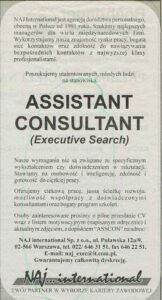
Archival NAJ International advertisement from 1998, the one I replied to when I started working in executive search. The contact details visible in the advertisement are no longer valid.
There was no LinkedIn, no professional profile search and no sourcing technology. We had a client brief, a conversation with the consultant, a list of companies, industry magazines, phone books and a landline. That was our working world.
The process still began in the same place where I believe it should begin today, with understanding who the organisation really needs.
First the market, then the names
Once we received a brief, we sat down with the role, the scope of responsibility and the client’s situation. Only then did we consider where people with the right experience might be working.
We built lists of companies in the relevant sector, with a similar business model, scale or structure. Specific names appeared at the end of that work, not at the beginning.
It is easy now to type a job title into a search engine and start with the people who appear on the screen. Back then, market knowledge had to be built piece by piece. We learned the companies, their brands, departments, competitors and the people connected with important projects.
The business press was one of our main sources. Every researcher had a set of publications to review regularly. Mine included “Życie Handlowe”, “Computerworld”, “Medycyna po Dyplomie” and “Warsaw Business Journal”.
I read them with a very specific purpose. I looked for people who had moved into new roles, taken responsibility for important projects, appeared as experts or were mentioned in news about company growth.
If the company and the role were relevant to one of our searches, that person went into the candidate database. First we had to check manually whether the name was already there. Sometimes the role was out of date. Sometimes the same function had been entered under a slightly different title.
The system did not recognise duplicates or suggest connections. It certainly did not update itself while we slept. The quality of the database depended entirely on the knowledge and attention of the people who built it.
Keeping information current was part of the research
I once found a sentence in an old instruction for working with the press “Newspapers that are not read regularly become useless.” It sounds almost painfully obvious. Yet it still says something important about research. Information matters when it is current, well chosen and understood in context. Better tools have not made that any less true.
We collected much more than names. We cut out information about companies, potential clients, ownership changes, investments and developments in particular industries. The material went into folders and binders dedicated to companies and sectors. The shelves really did bend under the weight.

Archival NAJ International office. Binders filled with press clippings and materials about companies and industries were once among the basic tools used for research and building market knowledge.
When I look at those binders now, I think this image shows how executive search has changed better than many presentations ever could. We keep knowledge differently now and we can reach it much faster. Still, research begins with knowing enough about the market to understand what a candidate profile actually means.
Finding the profile itself may take seconds. Understanding whether the person behind it has the experience a particular organisation needs is another matter.
Calling the switchboard and finding a way through
Phone books were mainly useful because they gave us company switchboard numbers. We called reception desks or secretariats and asked to be connected with someone in a particular function, perhaps a brand manager, a sales director or the head of a department.
It did not always go smoothly. Receptionists and assistants were real gatekeepers. A researcher needed patience, persistence and sometimes a little imagination.
There were days when reaching one person involved several calls and conversations with several different people. You simply kept looking for another way in.
Once we reached the right person, the first conversation was usually short. We explained the role and gave some basic context. If the project was not confidential, we also gave the client’s name.
There were fewer similar offers in the market at the time. An opportunity to join a growing international organisation could be interesting in itself.
The first interview usually took place at the recruitment company’s office. Even the location mattered. It had to be easy enough to reach during the working day, while still offering discretion.
Running into someone from the same industry on the way in could create a very awkward situation.
Today the first contact may happen through LinkedIn, email, phone or a messaging platform. The first conversation may take place online, and candidates have much more freedom to speak from wherever they happen to be.
Reaching people is technically easier now, although getting their attention for the right reasons still takes preparation.
From paper files to responsibility for data
By the end of the 1990s, candidate information lived in two worlds at once.
We were developing an electronic database, but paper CVs, motivation letters, photographs and interview notes were still arriving at the office. Everything had to be organised twice.
During that period, I led the first modification of our CRM system. We wanted it to reflect the way consultants and researchers actually worked and to organise the information collected during projects.
The CRM did not analyse the data for us. It was an electronic store of knowledge created by people. Its usefulness depended on the quality of what we entered.
Some recruitment processes at the time even used graphology as an additional source of information about candidates. Looking back, it feels almost anecdotal now.
Today we use structured assessment tools such as the DISC D3 assessment, which supports the analysis of behavioural style, internal motivation and decision making patterns. This is one of the areas where candidate assessment has changed enormously.
Data responsibility became part of the process
One of the more important projects I managed in those years was the registration of our candidate database with the Polish data protection authority, the General Inspector for Personal Data Protection.
Today we instinctively think of GDPR when personal data comes up. Our responsibility for candidate information began much earlier.
The work involved organising the rules for handling documents and contacting people whose information we already held. We asked candidates for consent to continue processing their data.
Only with time did I fully understand how important that shift was.
A candidate database could no longer be treated only as a business asset. It was also a responsibility towards real people whose private information had been entrusted to us.
As the binders disappeared, that responsibility stayed with us and grew with the volume of information technology allowed us to collect.
LinkedIn opened the market
The arrival of LinkedIn was a breakthrough, although I do not think any of us understood at first how large that change would become.
When I joined, the platform felt almost like a small business club. I got in through an invitation from someone who already had an account. There were not many users. Profiles were sparse, often without photographs or long descriptions, and very little happened there.
Still, seeing people from different companies and markets in one place felt extraordinary.
LinkedIn grew. It stopped being a small professional network and became a global platform where people present their experience, publish, build visibility and develop professional networks.
For recruitment, the practical difference was enormous. Career history, job title and current employer became much easier to check. International projects also became much easier to organise.
Suddenly thousands of professional profiles were visible. What I still needed was the context behind them.
A profile tells me where someone has worked. Yet it may say much less about the influence that person had on the business, the conditions in which they succeeded or the limitations they had to work around.
It does not tell me with certainty what someone needs at the next stage of their career. Nor can it tell me whether the opportunity I am bringing them fits what is happening in their professional life at that moment.
Finding the name became much easier. Understanding the person behind it still takes work.
More profiles do not make the search easier
Today we can identify more potential candidates in a day than we once found in several weeks. Longlists are longer and market access is much wider. In theory, this should make everything easier.
It does not always get us to the right person any faster.
Senior leaders receive many approaches from recruiters. They know their market value and they think carefully about change. A job title, even an attractive one, is rarely enough.
One person may be interested in building a team from the ground up. Someone else may want regional responsibility or the chance to lead a transformation.
Another candidate may be looking for greater influence over decisions. Someone else may turn down an attractive role because they no longer want to work in a business that depends heavily on a foreign headquarters.
Two people with almost identical career histories can react very differently to the same opportunity.
Candidates also look at employers differently now. They ask about the real scope of responsibility, the level of autonomy, the way decisions are made, the relationship with the board or headquarters and the reason the search has started.
They want to understand the conditions in which they will be expected to deliver. The title alone tells them very little.
The organisation is assessing the candidate. At the same time, the candidate is forming an opinion about the organisation, the people involved and the credibility of the process.
A large number of profiles therefore solves very little on its own.
The difficult part comes later. We need to understand the experience behind the profile, the person’s motivation, the possible risks and whether this particular move makes sense for both sides.
Are you planning to hire a leader for your organisation in Poland?
AI in executive search is another stage in the same story
I am now involved again in testing new CRM solutions and tools that use artificial intelligence.
From the perspective of someone who started with industry magazines, phone books and shelves full of binders, the scale of the change can still surprise me.
If I had to choose one moment that shows how executive search has changed most clearly, I would probably point to AI.
Artificial intelligence can organise large volumes of information, compare experience, prepare company maps, summarise project material and highlight areas worth exploring in a conversation.
Used well, it removes some of the mechanical work. That gives consultants more time for market analysis, candidate conversations and careful assessment.
I would not ask it to decide who should be recommended for a senior leadership role.
A tool works with the information it receives. Some excellent candidates simply do not spend much time describing themselves online. A polished profile, on the other hand, tells me very little about what someone actually achieved.
The more information technology gives me, the more important interpretation becomes.
A close match to the job description may look reassuring on paper. In practice, I am interested in a different question.
Can this person actually deliver what this organisation needs?
What the history of executive search has taught me
Almost every tool around us has changed.
The phone books disappeared first. Press clippings gradually gave way to digital sources. Paper folders became CRM and ATS systems.
Today even the first meeting may happen online. AI has joined the research process as well.
The job still starts with understanding the client’s situation.
We need to know what kind of experience is genuinely necessary. Then we need to understand where that experience is likely to sit in the market and which parts of the profile really matter.
We still have to separate a well written career history from real achievement. That requires understanding the scale of responsibility, the context in which decisions were made and whether the person is ready for the challenge ahead.
Discretion and trust matter just as much as they did before.
A candidate is not making a decision on the basis of a job description alone. The person running the process matters. So does the quality of the information and the way the candidate’s own professional situation is treated.
We now have more data than I could have imagined when I first joined NAJ. We can reach people faster and map a market in hours rather than weeks.
Sooner or later, however, I still arrive at the same question.
What kind of leader does this organisation really need, and why might this person be the right one?
This is where the tools reach their limit.
Search engines, LinkedIn and AI can give us an enormous amount of information. The final judgement still needs context, experience and a conversation with the person behind the profile.
Executive search is still a very human job
I would not want to return to checking every piece of information manually or to a pile of magazines waiting on my desk. Technology has made the work better in many practical ways.
People have not become easier to understand. Senior hiring decisions have not become risk free either.
I certainly do not want to give up the technology we have today. I want to use it where it genuinely helps. At the same time, I want to leave enough room for judgement, curiosity and real conversation.
When I look back at that advertisement from 1998, I sometimes wonder what my younger self would make of the tools on my desk today.
Probably very little.
I think she would recognise the job itself surprisingly well. She would still need to understand the market, listen carefully and take responsibility for the person she recommends.
That is how executive search has changed over 35 years. Almost everything around the work looks different now. The responsibility for understanding the client, the market and the person is still ours.
Frequently Asked Questions
Is LinkedIn enough to find the right executive candidate?
LinkedIn is very useful for identifying potential candidates, but a professional profile does not show the full context of someone’s achievements, motivation or readiness for change. Executive search also involves market analysis, direct contact with people who are not actively looking for a job and an assessment of how their experience fits a particular organisation.
What role does AI play in executive search today?
AI can support research, organise data, help with market analysis and prepare project material. I would not use it as the final judge of a candidate. Experience, motivation, risk and organisational fit still need to be explored through conversation and consultant judgement.
How is executive search different from standard recruitment?
Executive search begins with the market and the business situation rather than with incoming applications. The consultant defines target companies, approaches people who may not be looking for a new role and assesses whether the opportunity makes sense for both sides.
Why does market knowledge matter in executive search in Poland?
For an international company hiring in Poland, market knowledge helps translate a global brief into a realistic local search.
It shows where relevant leaders are likely to work and what level of responsibility may sit behind similar job titles. It also helps us understand expectations around compensation, mobility and decision making authority.
Without that context, even a strong looking candidate profile can be misleading.
How is confidentiality protected in senior leadership recruitment?
The amount of information shared depends on the stage of the search and the arrangements with the client. Candidate data is processed in line with applicable regulations. Information about the project, the organisation and the people involved is shared only when it is necessary.
Executive search ROI helps decision-makers compare the value of hiring a senior leader with the total cost of the recruitment process. It is especially important when the role affects productivity, continuity, turnover risk and strategic change.
More often, companies considering recruitment outsourcing ask whether working with an executive search agency can be justified financially. The answer depends not only on the agency fee, but also on vacancy costs, time to fill, quality of hire and the risk of a failed senior appointment.
What does ROI mean in executive recruitment?
Recruitment ROI is the financial comparison between the benefits of hiring and the costs of the recruitment process. In senior hiring, the calculation matters because one leadership decision can affect much more than one vacancy.
In executive recruitment, ROI refers to the value created by hiring a high-level leader compared with the costs incurred to find, assess and integrate that person into the organization. These costs may include recruitment fees, the time required to fill the position and the costs of onboarding a newly hired leader. Therefore, ROI in executive recruitment should not be reduced to the agency fee alone.
Which factors affect recruitment ROI?
Both costs and gains influence the result. The three most important factors are cost per hire, time to fill and quality of hire.
Cost per hire includes direct costs, such as the labour cost of internal employees assigned to recruitment, recruitment agency fees and advertising. It may also include indirect costs, such as lost productivity during the vacancy, training, onboarding and other relevant expenses. Time to fill is the number of days from the moment a position becomes vacant, through opening the recruitment process, until the offer is accepted and the new employee starts working. In lower-level roles, companies often simplify the endpoint and count only until offer acceptance. However, for senior positions, the real business impact often continues until the leader starts and becomes effective. Quality of hire measures how well the new employee performs and fits the organization after being hired.
As a result, a fast recruitment process is not enough if the selected leader does not deliver the expected contribution.
Why executive hiring creates long-term value
Executive hiring has a long-term effect on the organization. A successful senior appointment can improve productivity, reduce turnover costs and strengthen the company’s competitive position.
Leaders directly influence the performance of teams and the organization, which can translate into higher revenue. In addition, a well-selected leader is less likely to leave quickly, so the company avoids the cost of another recruitment and onboarding process.
Finally, effective leaders can drive innovation and strategic change, giving the company a competitive advantage.
How do you calculate executive search ROI?
The basic formula is simple: ROI = ((Gains − Costs) / Costs) × 100. In practice, the challenge is deciding which gains and costs should be included. Gains represent the value brought by the newly hired leader. This may include increased productivity, operational profit or savings from reduced employee turnover. Costs represent the total recruitment cost, including agency fees, the time spent on the process and the time required for the leader to fully integrate into the company structure. For executive search ROI, companies may also consider intangible benefits. These include stronger employer branding, higher customer and employee satisfaction, and better client relationships created through strategic decisions made by leaders.
Executive recruitment should not be evaluated only through the invoice for the service. The real question is what the organization gains, what risks it avoids and how quickly the right leader starts creating business value.
Agency versus internal HR department
The comparison between an executive search agency and an internal HR department should include time, cost, candidate quality, confidentiality, process management and guarantee.
The cheapest route at the beginning is not always the least expensive route in the end.
An executive search agency usually has established processes for building a search strategy and reaching the right candidates, including passive candidates. Agencies also specialize in roles that are rarely activated inside a single company, such as CFO, CEO, CSO, CPO, CHRO, General Manager, Chief Accountant, Production Director or board member roles. This can shorten the process and reduce vacancy costs. An internal HR department may appear cheaper because there is no external agency fee. However, internal recruiters often have other responsibilities, must build the recruitment strategy from scratch and may have limited reach among passive candidates. Consequently, the process may take longer and increase indirect costs.
Candidate quality and passive talent
Agencies often have broader access to talent pools and stronger experience in reaching leaders who are not actively looking for a job. This can result in a higher-quality leadership hire. Internal HR teams may rely more heavily on job postings and traditional methods. Moreover, limited experience in executive-level recruitment can increase the risk of hiring an unsuitable candidate, which later creates additional turnover costs.
Confidentiality and employer brand
Professional agencies are used to managing confidential recruitment processes. This is crucial when the company is hiring for a senior position or replacing a leader. Internal recruitment can make full confidentiality harder to maintain, especially in larger organizations. Additionally, candidate communication, interview coordination and feedback require consistency. If any stage is neglected, candidates may form a negative view of the company.
Guarantee and financial risk
Executive search agencies often offer a candidate guarantee. If the hired leader leaves or is dismissed within a specified period, usually 6 to 12 months, the agency may repeat the recruitment process at no additional cost or refund part of the fee. Internal HR departments do not offer this type of guarantee. Therefore, if the selected candidate is unsuitable, the company bears the full cost of another recruitment process.
Example comparison for a CFO recruitment
The original comparison shows why total cost matters more than the first visible cost. In this example, the agency fee is higher, but the total recruitment cost is lower.
Assumptions:
- Position: Chief Financial Officer
- Annual gross salary: EUR 120k, base plus bonus
- Executive search agency fee: 25% of annual salary, EUR 30k
- Internal HR department cost: EUR 10k
- Time to fill with an agency: 3 months, 90 days
- Time to fill with internal HR: 6 months, 180 days
- Vacancy cost: EUR 500 per day
The agency option assumes that the first shortlist is usually ready after 40 to 50 days. However, the chosen candidate’s notice period may extend the total time before the person starts.
| Factor | Executive search agency | Internal HR department |
|---|---|---|
| Recruitment costs | EUR 30k | EUR 10k |
| Time to fill | 90 days | 180 days |
| Cost of vacancy | EUR 45k | EUR 90k |
| Total recruitment costs | EUR 75k | EUR 100k |
| Guarantee | 12 months | 0 months |
Despite higher direct costs, the agency process results in lower total costs in this example. It also reduces the risk connected with a failed hire because of the guarantee offered.
Summary
Executive search ROI should be assessed through total business impact, not through the agency fee alone. Time to fill, vacancy cost, quality of hire, confidentiality and guarantee can change the real financial result of senior recruitment. For difficult leadership roles, an executive search agency may bring faster placement, stronger access to passive candidates and lower long-term risk. Internal recruitment may still be suitable in some cases, but the comparison should include indirect costs and the consequences of a wrong appointment.
Comparing executive search with an internal recruitment process?
Sources
-
Ewa Adamczyk, own 30+ years of experience in executive recruitment.
The executive search firms ranking 2026 shows more than the names of leading recruitment firms. For boards, owners and C-level leaders, it is a signal that executive search is moving from transactional hiring toward strategic advice, talent intelligence and AI-supported market insight.
Hunt Scanlon reports that executive recruiters entered 2026 from a position of strength, with the sector growing by 11 percent. At the same time, clients expect search partners to shape leadership decisions earlier, not only execute searches once a vacancy is already open.
What the executive search firms ranking 2026 shows
The 2026 ranking shows that scale, consultant depth and international reach still matter. However, they are no longer enough on their own. For international employers, the more important question is whether a search partner can combine global standards with credible local execution.
This is why networks such as IESF are important in international executive search. They give clients access to experienced local partners in multiple markets, while keeping the process coordinated, discreet and aligned with business goals.
However, a ranking should not be read as a simple buying recommendation. It is a useful map of the market, but it does not answer every question a board must ask. For example, it does not automatically show whether a firm knows a specific country, sector, salary reality or candidate culture.
Therefore, the best use of a ranking is comparative. It helps leaders understand which organisations are visible globally. Then it should lead to deeper due diligence: methodology, consultant seniority, references, confidentiality, reporting and local execution.
Why growth does not make partner selection easier
A growing market gives clients more choice, but it also makes the buying decision more complex. Hunt Scanlon reports that the executive search sector expanded strongly and that many firms recorded positive growth. In practice, this means more providers are competing for attention, more firms are repositioning themselves and more messages sound similar.
For a C-level buyer, the risk is not lack of options. The risk is choosing a partner whose brand, process or network does not match the real business challenge. A search for a regional CFO, Plant Manager or Country Manager in Poland requires different strengths than a global board advisory project.
As a result, leaders should not ask only “Who is ranked highest?”. A better question is: “Which partner can reduce the risk of this specific leadership decision in this market?”. That shift changes the conversation from visibility to suitability.
In this context, the executive search firms ranking 2026 should be treated as a decision-support tool. It helps narrow the field, but it does not replace direct assessment of the people who will run the search.
How AI and talent intelligence are changing executive search
AI is changing executive search, but it does not replace judgement, trust or market relationships. Hunt Scanlon describes a shift away from transactional models toward talent intelligence, AI integration and earlier influence in leadership decisions. This is one of the most important leadership hiring trends 2026.
AI can accelerate research, but it can also make weak conclusions look certain. In executive search, the consultant’s role is to verify the market, question the data and protect the board from decisions that look logical in a system but fail in real business conditions.
Talent intelligence can help search firms map candidate pools, analyse market movement and compare leadership profiles across countries. Moreover, AI-supported tools can improve speed and structure. Still, executive search remains a human advisory process because senior candidates rarely move only because they appear in a database.
The real value comes from combining data with consultant judgement. A strong partner can explain what the market data means, which candidates are realistic and where the offer may need adjustment. In other words, technology can accelerate research, but it cannot take responsibility for the final recommendation.
What C-level leaders should check before choosing a search firm
A ranking is a starting point, but due diligence should decide the final shortlist. Before choosing an executive search partner, boards and owners should test whether the firm can work with the real complexity of the assignment. They should not rely only on a convincing brand story.
Key questions include:
- Relevant sector experience: Has the firm completed similar leadership searches in your industry?
- Country knowledge: Can the consultants explain local salary expectations, notice periods and candidate behaviour?
- Consultant seniority: Who will actually lead the project and speak with senior candidates?
- Search methodology: How will the market be mapped, approached, assessed and reported?
- Confidentiality: How will the firm protect sensitive business information and candidate data?
- Evidence of results: Can the partner show references, case studies or a relevant track record?
For many companies, the best executive search firms are not simply the largest ones. Instead, they are the firms that combine reach, judgement, discipline and market-specific experience.
Why IESF strengthens international executive search in Poland and CEE
International reach must be matched with local expertise when the search concerns Poland or CEE. A global network is valuable when a company compares talent across markets. However, hiring a senior leader in Poland also requires knowledge of local business culture, compensation levels, notice periods and candidate motivation.
IESF gives international clients access to executive search partners who understand their local markets and cooperate across borders. This model is especially useful when a company needs consistency in process, but also expects market-specific advice in each country.
This is important for foreign companies entering Poland. A headquarters team may know the target profile, but it may not know how Polish executives evaluate risk, employer credibility, decision speed or relocation. Therefore, a local executive search partner should act as a translator between global expectations and market reality.
Used well, the executive search firms ranking 2026 can help international companies identify global players and networks. However, the final partner should also understand the local leadership market in detail.
For international employers, the IESF model is useful because it combines cross-border coordination with local accountability. More context on this cooperation model is available in International recruitment IESF.
How NAJ International supports international leadership searches
NAJ International supports foreign companies by combining Polish market knowledge with access to the IESF international network. This matters when a client needs both local execution and cross-border coordination.
As the exclusive IESF partner in Poland, NAJ International helps companies identify senior leaders, board-level candidates and key managers in Poland. The work includes market mapping, candidate approach, role calibration, assessment support and advisory input during the search.
For international employers, this combination is practical. IESF provides access to trusted executive search partners across countries, while NAJ International brings the local knowledge needed to run a senior search in Poland with accuracy, discretion and business context.
This approach is especially useful for international employers entering Poland, building a leadership team or replacing a senior manager confidentially. In these situations, the international executive search partner must understand not only the job description, but also the business risk behind the appointment.
For companies planning senior appointments in Poland, the service page Executive Search in Poland explains how NAJ structures leadership searches, market mapping and candidate assessment.
If you need evidence of work across sectors, see Executive Search References Poland, where NAJ presents selected client references and cooperation examples.
Summary
The 2026 ranking is useful because it shows how the market is changing, not only which firms are visible.
Growth, AI and talent intelligence are making executive search more strategic. However, they also make partner selection more demanding.
If you are planning a senior leadership search in Poland or CEE, use the ranking as a market map. Then test each potential partner against the role, sector, country, confidentiality level and business risk. NAJ International, as the exclusive IESF partner in Poland, can help you turn that comparison into a practical search strategy.
Planning a senior leadership hire in Poland or CEE?
Frequently Asked Questions
What does the 2026 executive search ranking show?
The ranking shows which global search firms and networks are visible in the executive search market. It also reflects broader market changes, including growth, AI adoption and stronger demand for leadership advisory.
Is the largest executive search firm always the best choice?
Not always. Large firms may offer global reach, but the best partner depends on sector expertise, consultant seniority, local knowledge and the specific risk behind the hire.IESF connects experienced executive search partners across markets. This helps international clients combine cross-border coordination with local knowledge in each country.
Why is IESF relevant for international executive search?
IESF connects experienced executive search partners across markets. This helps international clients combine cross-border coordination with local knowledge in each country.
Why should foreign companies work with a local partner in Poland?
A local partner understands salary expectations, notice periods, candidate behaviour, business culture and regional talent pools. This helps foreign companies make more realistic and safer hiring decisions.
Key challenges for CEOs in Poland in 2026 revolve around five connected areas: profitability, growth, AI, talent, and risk.
For leadership teams, these are no longer separate topics. They now shape one operating agenda.
Polish CEOs are trying to protect margins while still building room for expansion. At the same time, they are making decisions under stronger market, technology, and geopolitical pressure than a year ago. The latest NAJ/IESF findings for Poland show that the top priorities include cost management and profitability, market expansion, digital transformation and AI, talent acquisition and retention, and geopolitical and economic risk management.
Why the key challenges for CEOs in Poland in 2026 are different
The biggest shift is that strategy and execution now move together.
A CEO can no longer separate financial performance from technology, people, and resilience.
Until recently, many companies could transform in stages. First, they optimized costs. Then, they pushed commercial growth. Only later did they modernize operations and management systems. Today, that sequence is harder to maintain.
The Polish CEO dataset shows a clear balance between financial discipline and growth ambitions. On one side, cost management and profitability remain the most frequently mentioned strategic priority. On the other, market expansion, AI, and talent are also high on the list.
That changes the nature of leadership. A CEO is no longer managing only the budget or only the strategy. Instead, the role is about managing the company’s ability to execute under constant pressure and changing conditions.
Therefore, any serious discussion about the CEO agenda in Poland in 2026 should start with sequencing. Not every challenge must be solved at once. However, leadership teams need to know which issue is slowing growth or weakening performance right now.
Which priorities dominate executive decision-making
Margin protection, growth, and execution capacity are now at the center of the CEO agenda.
AI is becoming a management tool, not just a technology initiative.
In the Polish research sample, the highest-ranked priorities were cost management and profitability, market expansion and international growth, digital transformation and AI, talent acquisition and retention, and geopolitical and economic risk management. This is a pragmatic structure. It suggests that CEOs are not looking for fashionable concepts. They are looking for control, visibility, and sustainable growth.
In practice, the agenda often looks like this:
- Profitability: the company must protect margins, simplify operations, and control fixed costs.
- Growth: the organization wants to enter new markets or grow its share in existing ones.
AI and digital capability: leadership expects better productivity, stronger data quality, and faster decisions. - Talent: without strong leaders in critical roles, strategy does not translate into execution.
- Risk: the business must respond to regulatory shifts, economic uncertainty, and supply chain exposure.
That is why key challenges for CEOs in Poland in 2026 cannot be reduced to one issue. In reality, executives must balance several tensions at the same time. They need to save and invest, accelerate and reduce risk, adopt AI and keep teams engaged.
Sector differences also matter. In manufacturing, operational efficiency, supply chain stability, and margin protection are especially visible. In technology and IT, scaling, innovation, and access to critical capabilities take on greater weight. In service sectors, customer experience, process efficiency, and team quality often become more important.
Where companies lose execution speed most often
The problem is rarely the strategy itself. More often, the breakdown happens between board-level decisions and organizational action.
The first barrier is a mismatch between ambition and capacity. Leadership teams plan growth, but the business still lacks the people, processes, or data needed to sustain it. As a result, the strategy looks convincing in presentations but weaker in operations.
The second obstacle is leadership depth. When the right leaders are missing, even a strong strategy loses momentum. This is especially true for roles that combine commercial responsibility, operational ownership, and change leadership. That helps explain why talent acquisition and retention remain so high on the Polish CEO agenda.
A third source of delay is an overloaded transformation portfolio. Companies launch multiple initiatives in parallel, yet they do not assign one clear owner for the outcome. In that situation, each function may perform reasonably well on its own terms, but the business still fails to move at the right speed.
A fourth trap appears around AI adoption. Some organizations invest in tools, but they do not change how decisions are made. Technology alone will not create momentum if managers still work with fragmented data, unclear accountability, and inconsistent KPIs.
That is why leadership teams should return to a few simple questions. Which roles are critical to execution? Where is margin erosion actually happening? Which decisions will have the greatest impact over the next quarter? Only then does transformation become operational rather than symbolic.
What CEOs should do in the next 90 days
The strongest companies do not try to fix everything at once. They start with a few decisions that unlock execution. A practical 90-day plan usually includes four steps.
Set one shared priority for the leadership team
First, the board should define one core outcome for the quarter. It may be margin recovery, sales growth, implementation speed, or stabilization of a critical function. What matters is that the leadership team understands that priority in exactly the same way.
Map the roles that are critical to strategy execution
Next, the company should identify which roles truly hold the business together. In one case, that may be the COO. In another, it may be a Plant Manager, CFO, or transformation leader. Without this map, it is difficult to make talent decisions that support delivery.
Separate what is important from what is merely urgent
The next step is to reduce the number of parallel initiatives. If everything is strategic, nothing is truly strategic. Therefore, companies need to focus on the projects that directly affect performance or resilience.
Build a simple decision and risk review rhythm
Finally, the organization needs a short and regular management rhythm based on data. This matters even more when cost pressure and geopolitical exposure are rising. In practice, key challenges for CEOs in Poland in 2026 demand fewer declarations and more clarity around decisions, owners, and deadlines.
In 2026, the biggest challenge for CEOs in Poland is not choosing between profitability, growth, technology, or talent. It is leading all four at the same time without losing execution speed.
Want to better understand which roles and decisions will matter most for strategy execution in 2026?
NAJ supports companies in assessing leadership priorities, mapping the market, and planning critical hires. This article is primarily meant to help structure the topic and show where execution risks most often emerge today.
Does delivering your strategy depend on filling a critical leadership role?
Frequently Asked Questions
What matters most for CEOs in Poland today?
The central task is to balance performance with the company’s ability to keep growing. In other words, businesses need to protect margins, invest selectively, and strengthen leadership capacity at the same time.
Is AI already a board-level priority?
Yes. AI is increasingly treated as part of productivity, decision quality, and operating control rather than as a standalone IT topic. The Polish CEO data also confirms its growing importance.
Why is talent still such a high priority?
Because strategy slows down without the right leaders in place. A company may have capital, demand, and a strong plan, but without capable people in critical roles, execution weakens.
Which risks should boards monitor most closely?
In most cases, the answer is a mix of cost pressure, regulation, geopolitical uncertainty, and operational exposure. The goal is not only to identify risks, but also to build the ability to respond quickly.
Sources
-
Poland – Country Highlights 2026, NAJ/IESF, base: 56 CEO interviews.
Confidential hiring in Poland matters whenever a visible recruitment process could damage your business plan, create internal disruption, or leak competitive intelligence.
In practice, confidentiality protects three things: your strategy, your current leaders, and the candidates you want to attract.
What “confidential hiring in Poland” means in practice
Confidential hiring in Poland is not “no information at all.” It is controlled disclosure, designed to protect your business while keeping candidates engaged.
That usually means the role is described without naming the company (or the exact unit/location), the shortlist is shared only with named stakeholders, candidates are contacted directly (no public ads), and sensitive documents are shared later – typically under an NDA.
For international employers, confidential hiring in Poland can also support quiet market entry, before competitors and media connect the dots.
Why confidentiality is a competitive advantage in the Polish market
Poland is an attractive talent market, but leadership hiring is competitive. The best candidates are often employed and risk-aware, and they respond faster when they see professional process control.
When confidentiality is handled well, you attract stronger passive candidates, reduce internal noise and retention risk, protect your market entry or transformation timeline, and prevent competitors from reading your next move.
It improves access to passive candidates
Senior leaders rarely apply to visible ads. They engage when the process is discreet, structured, and clearly aligned with data protection expectations.
It protects strategy and stakeholder trust
Confidentiality reduces speculation and helps you control timing. This is especially important for market entry, sensitive transformations, and leadership changes.
Confidential hiring in Poland helps you protect:
- Strategic intent (market entry, product moves, investment plans)
- Business continuity (leadership transitions, turnarounds, restructurings)
- Candidate privacy and engagement (especially among passive executives)
Confidential hiring in Poland: 7 common scenarios
Confidential hiring in Poland is most critical when recruitment visibility creates operational, reputational, or competitive risk. Below are seven scenarios where discretion directly protects outcomes.
In each case, the goal is not “silence.” The goal is a controlled process that limits leakage, keeps stakeholders aligned, and maintains candidate trust.
1) Replacing a current leader
If you are replacing a CEO, CFO, Plant Director, or Country Manager, discretion is essential. A visible process can trigger panic, political behaviour, and early departures. What to protect: timeline, stakeholder narrative, and business continuity.
Replacing a senior leader is one of the most sensitive moments in an organisation. In Poland, confidentiality in executive recruitment is not just good practice – it is risk management. NDAs, staged information release, and strict stakeholder access reduce internal noise, protect business continuity, and safeguard sensitive business information throughout the search.
2) Market entry or launching a Polish entity
When you are entering Poland, hiring is an early market signal. Competitors can infer your target customers, location strategy, product plans, and investment size. Confidential hiring in Poland lets you build leadership capacity before the market reacts.
3) Restructuring, turnaround, or crisis recovery
During restructuring, rumours spread fast. A visible search can intensify fear inside the organisation, supplier uncertainty, and client hesitation. Confidential hiring in Poland helps you fill critical roles without adding pressure to an already sensitive situation.
4) Building a new function before you announce it
Examples include strengthening compliance, cybersecurity leadership, or M&A capability. Early exposure can create unwanted attention from regulators, competitors, or other stakeholders. Confidential hiring in Poland protects strategic intent and readiness.
5) Roles involving sensitive information
This includes leadership positions connected to finance and cash strategy, cybersecurity and incident response, pricing and procurement, or strategic planning. In these searches, confidentiality is not a “nice to have.” It is risk control.
6) Competitive poaching and talent wars
If competitors learn you are hiring for a key role, they may counter-offer your target candidate, approach your current leaders, or launch a defensive hiring campaign. A discreet approach reduces the chance that your recruitment becomes market news.
7) Preventing a domino effect inside the organisation
Even if you are not replacing someone directly, visible hiring for a senior role can trigger assumptions about reorganisation, shifting budgets, or loss of influence. That can lead to unnecessary turnover. Confidential hiring in Poland helps you control the internal message and timing.
How an Executive Search partner keeps the process discreet
Confidential hiring in Poland works best when discretion is supported by repeatable procedures—not informal caution. A strong Executive Search partner builds confidentiality into the process from the start.
The goal is to protect sensitive information while keeping the search efficient, candidate-friendly, and compliant with data handling expectations. If you want to review how we approach sensitive projects, see our AI policy for executive search and related confidentiality principles.
NDAs and staged disclosure
At the start, an NDA defines what can be shared, with whom, and at what stage. For highly sensitive searches, candidates may also sign a confidentiality letter before receiving identifying details. Confidentiality is strongest when it is planned, not improvised.
Direct outreach instead of public exposure
For leadership roles, direct search limits information leakage and reaches passive candidates who avoid visible job moves. This is why confidential hiring in Poland is often delivered through Executive Search rather than open advertising.
Tight stakeholder access and “need-to-know” rules
Leaks often happen when too many people have uncontrolled access. A disciplined process limits the stakeholder group, defines one communication channel, and sets rules for sharing materials and feedback.
Candidate experience that signals professionalism
Senior candidates look for clear timelines, clear data handling, minimal exposure, and respectful communication. When candidates trust the process, they engage faster and stay engaged longer.
A short checklist for international employers
If confidentiality matters, set the rules before you start outreach. A short pre-alignment meeting with stakeholders often prevents most confidentiality risks later.
Use this checklist as a baseline for confidential hiring in Poland. If you are comparing providers and process models, you may also want to review our Executive Search in Poland FAQ.
Checklist for confidential hiring in Poland:
- Define the confidentiality level: anonymous client vs. named client from the start.
- Limit stakeholders: decide who sees what, and when.
- Create a “safe” role description: accurate, but not identifying.
- Agree on a communication rhythm: fewer touchpoints, higher quality.
- Plan disclosure milestones: NDA → company reveal → deeper materials.
- Protect internal narrative: define what you will say if rumours start.
- Decide on background checks timing: late enough to avoid leakage, early enough to manage risk.
Planning a confidential executive search in Poland?
Closing: when discretion protects results
If your role relates to leadership change, market entry, restructuring, or sensitive information, confidential hiring in Poland should be the default. It protects your strategy, reduces internal disruption, and improves candidate response. With the right process discipline, confidentiality does not slow the search. It often makes decisions faster and cleaner.
Frequently Asked Questions
Is confidential hiring in Poland legal and compliant?
Yes. Confidential recruitment can be conducted in Poland, provided that candidate personal data is processed in line with GDPR requirements and access to sensitive information is properly controlled. Confidentiality does not replace data protection obligations – it defines how sensitive business information is shared during the process.
When should we reveal the company name to candidates?
There is no single disclosure point for every search. In sensitive projects, the company may remain anonymous during the initial approach and be revealed at an agreed stage, sometimes after an NDA has been signed. The key is staged disclosure: candidates receive the information they need at the right moment, without exposing sensitive business context too early.
Does confidentiality slow down recruitment?
No, if the process is designed properly. Clear disclosure rules, limited stakeholder access and an agreed communication process can make decisions faster by reducing uncertainty and unnecessary information flow. Confidentiality becomes a source of delay mainly when these rules are not defined at the start.
What is the biggest confidentiality risk in practice?
The biggest risk is usually uncontrolled access to information. Too many stakeholders forwarded candidate profiles, inconsistent communication or premature disclosure of the business context can expose a sensitive search. Clear access rules and a defined communication process help keep the information under control.
A well-planned executive search process in Poland helps avoid these risks. Our agency typically presents a shortlist of candidates within 5–7 weeks (depending on the seniority and complexity of the role, the rarity of the profile on the market, or the location, which can influence candidate interest). This timeframe gives investors rapid access to motivated individuals who meet the project’s requirements. However, the total time to fill a position (until the candidate actually starts working) ranges from 10 to 25 weeks, due to Polish labor law, which allows for notice periods of up to three months for long-tenured managers. It is a key difference worth remembering when planning an investment timeline.
Recruiting managers and specialists in Poland is a challenge faced by investors from countries such as Korea, Germany, Austria, the Netherlands, Denmark, as well as the USA and the UK. Poland offers highly qualified managers and engineers, a well-developed IT services sector, and a stable economic environment. At the same time, competition for talent can be intense, and mistakes in the process may delay market entry into Poland or the wider CEE region — and postpone the opening of a plant or R&D center by several months. How can foreign companies effectively recruit managers in Poland?
At this stage, many investors ask: “Is it really easy to make a recruitment mistake in Poland — and how can we avoid it?”
Why Is It Easy to Make a Hiring Mistake in Poland and How Can You Avoid It?
The most common reason for delays in recruiting managers in Poland is underestimated timelines and budgets. Many investors assume that filling a key role will take 4–6 weeks — yet in practice, building a shortlist of candidates takes around 5–7 weeks, and the actual onboarding (from the moment the candidate is selected) requires an additional 4–12 weeks, counted from the first day of the next month after the candidate submits their resignation at their current company. Managers in Poland typically have notice periods of up to three months. This is not “search time” but a requirement of Polish labor law.
What Mistakes Do Foreign Companies Most Often Make in Poland?
- Unrealistic timelines – a global HR Director assumes 4 weeks, while the real time needed to fill a role is at least 10–25 weeks.
- Salary ranges set too low – for example, an Asian company tried to hire a Process Engineer using 2022 salary levels, which resulted in zero candidates.
- Copy-pasted job descriptions – a “global template” prepared in Germany did not take into account that a Polish Quality Manager is also responsible for team management.
- Overly narrow location – a U.S. IT company searched only in Warsaw; results came only after opening the search to Wrocław and Poznań (hybrid model).
How to Avoid These Issues?
- Reliable market benchmarking – verifying real salary ranges and competition in a given location.
- Adjusting the profile to Polish realities – for example, an HR Manager in Poland usually has a broader scope of responsibilities than in local plants in Spain.
- Direct search instead of relying solely on job ads – the best, highly qualified candidates are passive and do not apply to postings.
- Location flexibility – hybrid work, relocation options, or a satellite office significantly expand the talent pool.
How to Build a Strong Candidate Value Proposition? (Cultural Differences in Practice)
The Polish job market is a candidate-driven market — it is candidates who choose the employer, not the other way around. This means that salary alone is not enough to attract a manager or specialist. Equally important is how you communicate your offer and whether you can translate the culture of your headquarters into a local, meaningful value proposition.
The most common mistake investors make? Assuming that the Polish market will simply “adapt itself” to their culture. In practice, Korean or Chinese companies, for example, need to adjust the focus of their communication to earn candidates’ trust.
Korean Companies in Poland – How to Overcome the Perception of Hierarchy?
Korean organizations are often seen in Poland as highly hierarchical and formal. Many candidates fear that working in such an environment will mean limited influence on decisions and reduced autonomy. That’s why a well-prepared executive search process for Korean companies in Poland should emphasize the greater independence of local operations.
How to Improve This?
- Emphasize that recruiting for Korean companies in Poland is not about copying global structures but about showing candidates the added value of working within their culture.
- Example: A Korean manufacturing company improved retention after introducing a “local ambassador” program – a Polish Operations Director who became the face of candidate communication.
German and Austrian Companies – How to Communicate KPIs Clearly?
German and Austrian companies are known for precision and a strong focus on processes. This is an asset, but also a challenge: Polish candidates do not always understand what extensive KPI tables truly mean. Effective recruitment for German and Austrian companies in Poland should highlight the business impact of the role, not just the procedures.
How to Improve This?
- Speak the language of outcomes: “Your decisions as a Quality Manager will influence production standards across the entire European factory network.”
- Show a clear promotion path for managers in Poland, e.g., from Plant Manager to a regional role.
- Instead of a long list of responsibilities, create a description such as: “You will manage a team of 30 people and oversee quality indicators across 5 production lines.”
Dutch and Danish Companies – How to Highlight Partnership and Trust?
The organizational culture in the Netherlands and Denmark is built on partnership and trust. Polish candidates generally appreciate this style, but do not always believe that in a large multinational corporation they will truly have influence. Recruitment for Dutch and Danish companies in Poland should therefore emphasize that local managers’ voices matter.
How to Improve This?
- Show concrete examples of co-decision-making, e.g., “The HR Manager in Warsaw co-creates the global benefits policy.”
- Replace an interrogation-style interview with a panel discussion — this signals partnership.
- Case: A Danish food company hired a Factory GM in Poland who was promoted to global COO within 18 months. Candidates were persuaded by the clear, tangible impact shown already during the recruitment process.
American and British Companies – How to Make the Promise of “Global Projects” Credible?
Companies from the US and the UK often highlight innovation and participation in international projects. This strongly appeals to Polish candidates, especially in IT and R&D. Problems arise when, in practice, the role turns out to be a local “delivery center.” Therefore, recruitment for American companies in Poland should clearly show which global initiatives the Polish team will actually participate in.
How to Improve This?
- Instead of vague statements like “participation in international projects,” give a concrete example: “As a Software Engineering Manager, you will co-lead the implementation of an AI platform across five countries.”
- Build credibility by pointing to real clients and global projects.
- Case: A US IT company in Warsaw attracted senior engineers only after adding to its offer: “participation in client meetings in London and New York” — instead of simply “working on the code.”
Salaries, Benefits, and Employment Models – What Really Matters on the Polish Job Market
On the Polish job market, candidates look beyond base salary alone. What matters is how much they take home, what benefits are offered, and the form of employment. That’s why effective recruitment of managers in Poland requires flexibility and an understanding of local expectations.
Managerial Salaries – When Are They Close to Western Levels, and When Still Lower?
It is no longer accurate to say that managers in Poland are “always much cheaper” than in Western Europe. The gap is narrowing, especially in technology and financial sectors. Data from GUS and Eurostat (2025) show that in IT and automotive, managerial salaries in Poland reach 70–80% of Western European averages.
Salary levels depend on:
- industry (IT, automotive, advanced manufacturing),
- location (Warsaw, Lower Silesia, and the Tri-City region pay more than peripheral areas),
- company size and employer brand.
This is why executive search in Poland must incorporate solid market benchmarking — otherwise, salary ranges can easily miss the mark.
Benefits That Candidates Expect Today
In 2025, benefits have become a standard, not a luxury. According to the Up Bonus report (February 2025) published by HRstandard.pl, nearly half of employees in Poland indicate private healthcare as the most important perk. Well-being programs and flexible work arrangements are gaining importance as well.
The most commonly expected benefits include:
- well-being programs and psychological support,
- flexible working hours and hybrid models,
- family-oriented benefits (e.g., healthcare packages for dependents),
- company car/fuel card for mobile roles,
- personalized benefits packages (cafeteria systems).
This is why employee benefits in Poland 2025 are a key element of managerial negotiations and cannot be treated merely as an “add-on” — they are an essential part of the candidate value proposition.
Employment Contract vs. B2B – What Works Best Today?
The form of employment is one of the most frequently negotiated topics in the Polish market. Candidates in manufacturing and industrial sectors usually prefer an employment contract (umowa o pracę) because it offers stability and social benefits. In contrast, in IT and technology roles, the B2B model is popular — often in a hybrid formula (part employment contract + part consulting contract).
This is why investors should opt for flexible employment models in Poland. Only then can the offer be aligned with a candidate’s expectations and prevent competitors from winning talent simply by offering a more attractive contract structure.
Recruitment Process and Contingency Planning – How to Minimize Risks
Many investors assume that recruitment in Poland is a simple process: a job posting, a few interviews, and it’s done. In reality, the Polish market is highly competitive. This is why executive search in Poland is not only about finding candidates but also about effective risk management.
What Does a Well-Designed Recruitment Process Look Like?
- Briefing and role validation – checking whether the role profile is realistic and recruitable on the market, whether the salary range is competitive, and whether the location limits access to candidates.• Example: A U.S. IT company wanted to hire a Software Engineering Manager only in Warsaw. After the analysis, they opened the search to Poznań and Wrocław – which unlocked several dozen additional candidates.
- Market mapping and direct search – preparing a list of target companies and approaching passive candidates. This is essential, because recruiting managers in Poland requires reaching people who do not apply to job postings.
- Shortlist and interviews – typically 4–6 candidates selected based on competencies and cultural fit. Transparency is key – candidates want to know the timeline and next steps.
- Offer and negotiations – not only salary matters but also benefits, relocation packages, and company car options.
The Most Common Risks – and How to Address Them
- Profile too niche – clients sometimes search for a “unicorn” candidate with an unusually rare combination of skills. In practice, such profiles may be nearly impossible to find.
Plan B: Split responsibilities into two roles.
Plan C: Hire someone with the key skills and upskill them in the remaining areas. - Underestimated budget – when compensation is lower than competitors’, candidates withdraw.
Plan B: Adjust the level of the role (e.g., hire a Senior Engineer instead of a Manager).
Plan C: Add attractive benefits instead of a salary increase. - No shortlist delivered on time – typically due to an unclear brief or unclear requirements.
Plan B: Open the search to additional locations or alternative employment models.
Plan C: Provide the client with a market analysis showing the real number of available candidates. - Candidate rejects the offer at the last moment – common in Poland due to strong counter-offers and competitive poaching.
Plan B: Keep a runner-up candidate active until the final decision.
Plan C: Set an offer validity date and run parallel conversations.
Case Study – How a Contingency Plan Saved the Recruitment
A German automotive company was recruiting a Maintenance Manager in Silesia. After all interview stages, the selected candidate declined the offer because a competitor doubled his benefits package. The agency, however, had prepared a reserve shortlist – and the runner-up was hired within a week. As a result, the project stayed on schedule, and the company recognized the strategic value of contingency planning in executive search for foreign companies in Poland.
The recruitment process in Poland must be treated like a project – with a timeline, alternative scenarios, and clear communication. Executive search for foreign companies in Poland is not only about identifying candidates but also managing risks that, in practice, determine the success of the investment.
Mini Case Studies – What Worked for Foreign Companies in Poland?
Nothing convinces investors better than real market examples. In executive search, success depends not only on methodology but also on experience from concrete projects. Here are four short stories showing what determined recruitment success.
Scandinavian Food Company – How to Build a Succession Path
A Danish food company was opening a plant in Poland and needed a Factory GM. Candidates were concerned that a “factory in Poland” would be a career dead end. Only after the company clearly presented a path toward global advancement did one of the managers accept the offer – and after 18 months, he was promoted to COO.
This example shows how recruitment for Scandinavian companies in Poland can succeed when candidates clearly see real development opportunities.
German Automotive Company – The Plan B That Saved the Project
A car parts manufacturer needed a Maintenance Manager. The selected candidate rejected the offer after receiving a counteroffer from his current employer. Thanks to a runner-up who was hired within a week, the production line launch proceeded as planned.
This demonstrates that executive search for German companies in Poland must always include a contingency plan.
American Technology Company – How to Attract Passive Candidates
A U.S. corporation was opening an R&D center in Warsaw. Job postings attracted mostly junior candidates, with a shortage of seniors and leaders. Only direct outreach to passive candidates — combined with the promise of real influence on a global AI platform and meetings with clients in London and New York — enabled the company to build the team.
This is how effective recruitment for American companies in Poland works.
What’s Next? Concrete Steps for the Client
If you are a foreign company planning expansion in Poland, the most important question is: are your recruitment assumptions realistic? It’s worth verifying this before final decisions are made regarding budget or the timeline for launching the local operation.
Free Initial Consultation
During a 15–30-minute online meeting:
- we will verify whether the role profile is recruitable in the given location,
- we will discuss salary ranges and a benefits package that will be competitive,
- we will outline what the recruitment timeline will look like – from briefing to the final offer,
- we will explain how we conduct weekly updates and search reports,
- we will present the sourcing strategy – how we will map the market and from which industries and companies we plan to acquire candidates.
Mini Checklist for the Client
Before starting the project, ask yourself three questions:
- Do I know what the candidate market for this role looks like in Poland?
- Is the budget and benefits package competitive compared to local employers?
- Do I have a Plan B if the ideal candidate rejects the offer?
Summary
Effective recruitment in Poland is a project that should begin with a solid diagnosis. A short consultation will help you avoid mistakes that can lead to delays and financial losses.
Contact us to schedule a short consultation
Frequently Asked Questions
How long does it take to recruit a manager or specialist in Poland?
A Short List takes on average 5 to 7 weeks for mid-level roles (e.g., HR Manager, Quality Manager). For strategic positions (Plant Manager, Operations Director), the process to Short List takes 8–12 weeks, and candidates often have 3-month notice periods under Polish labor law. Additional time must be added on the client’s side for interviews across multiple decision-making levels, including meetings with senior regional or HQ directors who are often difficult to schedule. This is why executive search in Poland must be planned with consideration not only of the recruitment process itself but also of the onboarding timeline for the selected manager.
Do we need to publish job advertisements? Recruit effectily in Poland.
Not always. In executive search, most top candidates are passive — they do not respond to job postings, but they can be convinced through a well-conducted initial phone approach by the Search Consultant followed by a highly substantive interview with the Lead Consultant managing the project. Job ads play a supplementary role. This is especially important in managerial recruitment in Poland, where candidates expect direct contact and a partnership-driven conversation.
What are the costs of working with an executive search agency?
There are three models on the market: success fee, retained search, and the hybrid model. Each has its advantages and limitations.
- In the success fee model, the fee is charged only after the candidate is hired — attractive, but often resulting in a faster and shallower research process.
- In the retained search model, fees are split into stages, ensuring thorough market coverage.
- The hybrid model combines elements of both.
This is why knowing the costs of executive search in Poland is crucial when planning a project.
How does confidentiality work in the recruitment process?
Confidentiality is standard — and for many companies, essential. Confidential recruitment means the company name is not disclosed at the beginning. The candidate learns the employer’s identity only after expressing interest and passing initial qualification. This is one of our core areas of expertise — executive search for foreign companies in Poland is always conducted with full discretion and reputation protection for the client.
What if the ideal candidate rejects the offer?
This is a common risk — competition in Poland is very active. That’s why we always implement a plan B: we keep several finalists in the process, set an offer validity date, and prepare a runner-up. Such approach ensures that recruitment for American companies in Poland remains predictable and secure even in difficult projects. A recruitment guarantee is essential to avoid mis-hires.
Does a recruitment agency in Poland operate only locally?
No. We execute projects across the entire country — from Lower Silesia, through Silesia and Mazovia, to Pomerania and Podkarpacie. That’s why an executive search agency in Poland can support clients in multiple locations simultaneously, significantly accelerating expansion.
An executive search guarantee protects a company when a senior hire does not meet expectations within an agreed period. It is not only a contractual clause, but also a signal that the recruitment agency takes responsibility for the quality of its process.
For CEOs, HR Directors, CFOs, procurement leaders and business owners, the guarantee can influence the decision to choose a recruitment partner. Senior hiring is expensive, time-consuming and operationally sensitive. Therefore, the company needs more than a shortlist of candidates. It needs a partner that reduces risk before and after the hiring decision.
What is an executive search guarantee?
A recruitment guarantee is the agency’s commitment to take corrective action if the hired candidate does not meet the company’s expectations within a defined time frame. In practice, this usually means running a replacement process under agreed terms.
The typical guarantee period ranges from 3 to 12 months, depending on the seniority and complexity of the role. A longer guarantee gives the organisation more security because the agency remains responsible after the candidate joins the company.
For the client, the guarantee protects the investment in recruitment.
For the agency, it confirms confidence in candidate assessment, role understanding and process management. As a result, both sides enter cooperation with clearer expectations.
How does a recruitment guarantee reduce business risk?
A recruitment guarantee reduces business risk because a poor senior hiring decision can affect cost, operations and team stability. This is especially important in executive and managerial recruitment, where the wrong decision may create losses far beyond the recruitment fee.
Hiring for senior positions requires time from the board, HR, finance, procurement and operational managers. Moreover, when the process has to be repeated after a short period, the organisation pays twice. It pays in direct cost and in lost momentum.
For senior roles, an executive search guarantee gives the company a practical form of protection. If the new hire does not work out, the agency is expected to act quickly and support the client without restarting the commercial relationship.
The guarantee also helps reduce the perceived risk of choosing an external recruitment partner.
It shows that the agency is not stepping away after the placement, but remains involved in the outcome of the decision.
How does the guarantee influence candidate selection?
A long-term guarantee increases the agency’s commitment to precise candidate selection. If the agency accepts responsibility for the result, it has a stronger reason to verify not only experience, but also motivation, leadership style and cultural fit.
At this stage, the recruitment process cannot rely only on CV screening. The agency should understand the company’s strategy, organisational culture, team context and the real expectations connected with the role.
The selection process may include structured interviews, in-depth competency conversations, psychometric tools, reference checks and experience verification. Additionally, for senior roles, cultural fit assessment becomes particularly important.
A candidate may meet the formal requirements and still fail in the organisation. Therefore, the agency needs to assess how the person will work with the team, make decisions, communicate under pressure and adapt to the company’s values.
What must an agency understand before offering a guarantee?
Before offering a reliable replacement guarantee, the agency must deeply understand the client’s needs. This is the foundation of any senior recruitment process, especially when the position has strategic impact.
The agency should speak with key representatives of the company, including the CEO, HR Director, operational managers and the future team where possible. These conversations should cover formal requirements, leadership expectations, company values, upcoming challenges and business goals.
This approach helps the agency build a realistic candidate profile. It also allows the consultant to advise the client when expectations need refinement. As organisations grow, the original role profile may change. Therefore, the agency’s advisory role matters from the beginning.
A guarantee is credible only when the agency understands what success in the role actually means.
Without that context, even a strong candidate may be a poor match for the organisation.
Why does post-hire follow-up matter?
A guarantee should not cover only the selection process. It should also support the adaptation phase after the candidate joins the organisation.
Post-hire follow-up allows the agency to monitor whether the new employee is adapting well, meeting expectations and integrating with the team. Regular conversations with the employer and the hired candidate can reveal early warning signs before they become serious problems.
This type of cooperation gives the client additional peace of mind. It also shows that the agency is interested in long-term success, not only in closing the recruitment project.
Monitoring after hiring strengthens the practical value of the replacement guarantee.
If challenges appear early, the agency can help identify them and support corrective action.
How do market knowledge and industry expertise support the guarantee?
Market knowledge makes the guarantee more realistic because senior recruitment differs significantly between industries. A process for an IT leader may require different candidate assessment than a process for a manufacturing executive.
From the perspective of a CEO, HR Director or CFO, working with an agency that knows the relevant market provides additional security. Such an agency can better predict talent availability, identify key competencies and adjust the recruitment strategy to the realities of the sector.
Industry expertise also helps avoid recruitment errors. The agency understands which skills are critical, which expectations are realistic and how to position the opportunity for candidates.
The stronger the agency’s market understanding, the lower the risk of presenting candidates who look good on paper but do not fit the business context.
What role does organisational culture play?
Organisational culture is one of the key factors in senior recruitment success. A candidate needs the right qualifications, but also a leadership style that fits the company’s values, mission and management approach.
This is especially important in executive recruitment. Senior leaders influence teams, decisions and organisational habits. If the cultural match is weak, even a competent leader may struggle to build trust and deliver results.
The agency should therefore explore the client’s culture before candidate selection begins. This includes values, decision-making style, communication norms and expectations toward leadership.
A strong cultural match increases the chance that the new employee will stay, perform and contribute to the company’s long-term success.
It also makes the guarantee less likely to be needed.
What does a guarantee say about agency quality?
A guarantee confirms that the agency believes in the quality of its recruitment process. For HR teams responsible for choosing external partners, this can be an important proof of professionalism.
The agency that offers a meaningful candidate guarantee must be prepared to take responsibility for its recommendations. Therefore, it needs strong methodology, accurate assessment tools and a disciplined approach to client communication.
A guarantee also builds trust. The client knows that if something goes wrong, the agency has already committed to support the organisation. As a result, the cooperation can become more transparent and long-term.
For the agency, the guarantee is not only a risk. It is also a way to show confidence, accountability and service quality.
A guarantee should be understood as part of a broader responsibility for the recruitment result. It connects the quality of diagnosis, candidate selection, cultural fit and post-hire monitoring.
An executive search guarantee is not a marketing add-on. It is a test of how well the agency understands the role, the culture and the business risk before the candidate is hired.
Hiring for a role where one decision can have a real impact on the business?
Summary
A strong guarantee improves recruitment quality, protects the client’s investment and supports long-term cooperation between the company and the agency. However, it works only when it is backed by deep role understanding, precise selection, market knowledge, cultural fit assessment and post-hire follow-up.
If your organisation is choosing a recruitment partner for a senior or executive role, review not only the length of the guarantee, but also the process behind it. The real value lies in how the agency reduces risk before the hiring decision is made.
Frequently Asked Questions
How long is a typical recruitment guarantee?
A typical guarantee period ranges from 3 to 12 months, depending on the position and the terms agreed with the recruitment agency.
What does a replacement guarantee usually mean?
It usually means that the agency will take corrective action and search for a replacement candidate if the hired person does not meet expectations within the agreed guarantee period.
Why is a guarantee important in executive recruitment?
It is important because senior hiring involves high financial, operational and organisational risk. The guarantee gives the company additional protection if the decision does not bring the expected result.
Does a guarantee replace a good recruitment process?
No. The guarantee is valuable only when it is supported by a strong process, including role diagnosis, candidate assessment, reference checks and cultural fit assessment.
Sources
-
Na bazie własnych doświadczeń NAJ International.
Choosing the best candidate for a key role is rarely a purely rational decision. Even when the shortlist is strong and the data looks clear, managers still need to balance structured evaluation with intuition.
Making hiring decisions is one of the biggest challenges every manager faces. Therefore, this article explains how to approach candidate selection more consciously, especially when several finalists are highly qualified and the role will have a long-term impact on the business.
Intuitive versus rational decisions
Hiring decisions are rarely based on facts alone. Even with competency tables, references and several interviews completed, emotions still influence how we assess each finalist.
Recently, I spent several days visiting flooring stores. With each passing day, I knew more about types of wood, durability, colours and installation methods. However, instead of making the decision easier, this knowledge made it harder.
Standing in front of a shelf full of samples, I wondered: “Will this choice really be the right one for years to come?”
Does this sound familiar? Similarly, do you feel the same when you need to make a decision with long-term consequences? Selecting the best candidate for a key position can evoke similar feelings, especially when all finalists are highly qualified.
That is why it is worth looking at the decision-making process and understanding the mechanisms that guide our choices. Psychologists, including Daniel Kahneman, have shown that many decisions are made intuitively, based on emotions and previous experience.
In practice, our brain works in two modes:
- System 1, fast and intuitive. This is our automatic reaction, based on instinct and past experience. It is quick, but it can be affected by cognitive biases, such as the halo effect. For example, a positive impression during an interview may influence how we assess a candidate’s competencies.
- System 2, slow and analytical. This is the process of conscious thinking, which requires time and effort. In this mode, we analyse data, compare arguments and try to make decisions logically.
When choosing a candidate, both systems work together. Still, emotions often tip the scales, for example when a client chooses the person they “clicked with” during the interview, even though another finalist may have slightly stronger qualifications.
Neuroscience in decision making
A hiring decision engages both analysis and emotion. That is why a list of requirements alone is not always enough to feel confident at the final stage.
Brain research shows that decision making involves several key areas. First, the prefrontal cortex is responsible for analytical thinking and for evaluating the long-term consequences of a decision. This is where information about candidates’ competencies is processed.
Second, the limbic system deals with emotions and intuition. As a result, choosing a candidate with whom the conversation felt natural may be linked to the activity of this area.
In addition, mirror neurons are activated when we see similarities between ourselves and another person. As a result, a candidate who shares similar values or a similar communication style may seem like a “natural choice”.
Interestingly, the more information we analyse, the higher the risk of decision paralysis. This is known as the paradox of choice. When we have too many options, it becomes harder to decide, and we become more concerned that we may choose incorrectly.
Selection criteria for the best candidate
The best protection against decision chaos is a clear set of criteria agreed in advance. This helps the final discussion focus not only on impressions, but also on comparable evidence.
To simplify the decision-making process, it is useful to work with analytical tools such as a candidate comparison table. In the case of an Operations Director role, finalists may be compared across several categories.
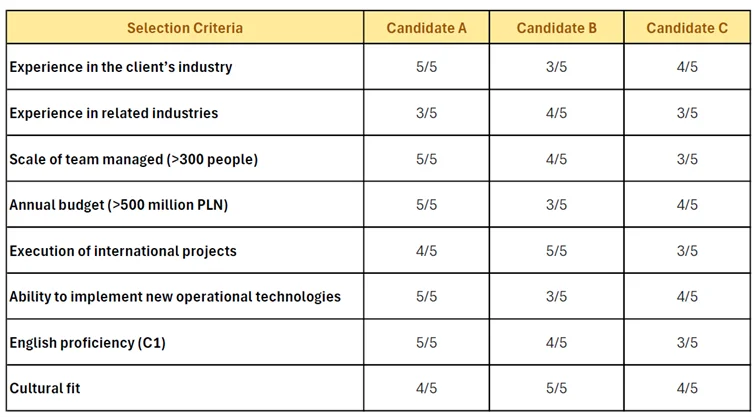
Comparing finalists against predefined criteria helps structure the decision and reduces the influence of interview impressions alone.
The criteria may include:
- Industry experience. Priority is given to professional experience in the client’s sector, for example energy, manufacturing or FMCG.
- Related sector experience. Knowledge of sectors adjacent to the client’s industry may bring valuable competencies and a broader perspective.
- Scale of team management. It is useful to compare the number of people directly and indirectly managed by the candidate. In large organisations, this may mean experience in managing teams of more than 300 people.
- Annual budget responsibility. Relevant experience may include responsibility for an operational budget that reflects the scale of the client’s organisation, for example at least PLN 500 million.
- International project execution. The number and scale of operational projects delivered across countries show whether the candidate can work effectively in a global environment.
- Implementation of new operational technologies. Experience in process optimisation and implementation of new tools may directly improve operational efficiency.
- English proficiency at C1 level. Fluent written and spoken business communication enables effective cooperation with international stakeholders.
- Cultural fit. Alignment between the candidate’s values, working style and the client’s organisational culture can be assessed through interviews, observations and structured criteria.
The criteria may include:
- Industry experience. Priority is given to professional experience in the client’s sector, for example energy, manufacturing or FMCG.
- Related sector experience. Knowledge of sectors adjacent to the client’s industry may bring valuable competencies and a broader perspective.
- Scale of team management. It is useful to compare the number of people directly and indirectly managed by the candidate. In large organisations, this may mean experience in managing teams of more than 300 people.
- Annual budget responsibility. Relevant experience may include responsibility for an operational budget that reflects the scale of the client’s organisation, for example at least PLN 500 million.
- International project execution. The number and scale of operational projects delivered across countries show whether the candidate can work effectively in a global environment.
- Implementation of new operational technologies. Experience in process optimisation and implementation of new tools may directly improve operational efficiency.
- English proficiency at C1 level. Fluent written and spoken business communication enables effective cooperation with international stakeholders.
- Cultural fit. Alignment between the candidate’s values, working style and the client’s organisational culture can be assessed through interviews, observations and structured criteria.
The outcome of the final decision
Making the final decision often brings relief, but it does not always remove all doubts. A client may still wonder whether another finalist would have performed better.
In such moments, it is worth remembering that the recruitment agency has already carried out a comprehensive selection process. Before presenting several finalists, it analysed dozens, and sometimes hundreds, of profiles.
Many clients make decisions partly based on emotions. They choose the person with whom the conversation went best or who made the strongest impression. However, this is not necessarily a wrong approach if all finalists have already been carefully assessed and matched to the role profile.
Moreover, recruitment agencies often offer a guarantee for the hired candidate, usually from 6 to 12 months. This provides additional security for the client and shows the agency’s commitment to the success of the hire.
Summary
Recruitment decisions require both analysis and intuition. Understanding how the brain works helps decision makers approach the final choice more calmly and responsibly.
As a result, structured tools, such as a candidate comparison table, help organise information and choose the person who best fits the organisation’s needs. At the same time, intuition still matters, because recruitment is about people, cooperation and trust.
Once the best candidate has been selected, it is worth trusting a well-managed process. Ultimately, the decision is not only about matching the job description, but also about finding a person who will work well with the team and support the company’s growth.
If you are facing a similar decision for a key role in Poland or CEE, it is worth discussing the assessment criteria, risks and process design before finalists reach the last interview stage.
Recruiting for a key leadership role?
Sources
-
Daniel Kahneman, Thinking, Fast and Slow.