

Fax, telegrams and patience

When I first started working at NAJ International, one of our main tools for communication in recruitment was the fax machine. We used it to send documents, confirmations and information between clients, candidates and consultants.

There was no email yet, so exchanging documents required patience. Every message had to be prepared carefully. Making a correction was not a matter of a quick click. You had to change the document, print it again and send it once more.

We also used telegrams to contact candidates. They had to be very short because you paid for every word. Today, this may sound like a curiosity from another era. At the time, it was a real form of fast communication.

It required discipline. You could not send a long message, explain everything in several paragraphs or follow up an hour later. You had to know what really mattered.

Today, we can send a job description, information about the company and a calendar invitation within minutes. That is a major improvement. Faster, however, does not always mean better.

Speed alone does not make a message clearer. A candidate still wants to know why we are contacting them and what the opportunity is about.

Contact started with a person and a lead

In the past, recruitment often started with a person, a contact and a lead rather than a candidate search engine. There was much less information available. Sometimes a consultant had to work a little like a detective. Referrals, conversations and knowing which question to ask the right person mattered much more.

If a company was looking for someone who spoke French, the first step might be to find someone who knew people with that skill. One conversation led to another. Only later would we verify experience, organisations, motivation and the actual fit for the role.

Today, the order is often reversed. We first see the industry, job title, languages and career history. Only during a conversation do we start to understand the candidate’s personality, way of working and expectations.

That earlier way of working taught us to pay attention. A referral was not a ready-made recommendation. It was the beginning of a path that still had to be checked. The consultant had to distinguish between a friendly suggestion and a genuine match. We also had to understand the difference between knowing a language and being ready to work in a particular role.

Some searches were even more demanding. In one recruitment project in the agricultural technology sector, candidates literally had to be found out in the field, by bicycle. Nobody had the telephone number of the manager of a remote farm.

It may sound funny today. At the time, it was simply another day at work.

That example says a lot about the profession. Successful recruitment has always required determination. Today, we have more data and more ways to make contact. But we still need to know how to reach places where others are not looking.

Newspaper ads and handwritten letters

In the early years, newspaper advertisements were an important way of reaching candidates. In Poland, they appeared in printed newspapers such as Gazeta Wyborcza. There were no online job boards, LinkedIn or platforms where you could quickly check who worked for a particular company.

Telephone identification was another important research tool at the time. Today, this would no longer be possible, including because of GDPR requirements.

A candidate would respond to an advertisement and send their documents by post or fax. Preparing an application took much more time than it does today. You could not simply complete a profile and click “Apply”.

For a period of time, we also worked with graphological analysis. Candidates wrote their cover letters by hand, and the original was sent to a graphologist we worked with. A fax was not enough because the pressure of the pen on the paper was also part of the analysis.

Graphology is not a standard part of professional executive search today. Historically, however, it shows how many different tools were used in an attempt to understand and assess a candidate’s potential.

First interviews were usually held in person

Candidates had to find time during the working day, travel to our office and make sure their absence did not attract unnecessary attention.

We also had to be careful that someone waiting in the corridor did not unexpectedly meet their own boss, who happened to be coming to another recruitment meeting with a different consultant.

Today, many first meetings take place online. Candidates do not have to spend several hours travelling. It is also much easier to run a process with people living in other cities or countries.

A conversation can start sooner. Yet a candidate will still notice very quickly whether the consultant knows their background, understands the role and can answer basic questions.

Technology helps. It does not replace preparation.

Landline phones and confidentiality

In the past, confidentiality required particular care. Candidates often included their home landline numbers on their CVs. The phone could be answered by another member of the household, a small child, a mother-in-law or an ex-spouse.

And the consultant was still responsible for discretion. Even asking whether it was a good time to talk had to be done without revealing too much.

Today, candidates have their own mobile phones and private email addresses. Communication in recruitment is more direct. However, there are new situations we need to watch out for.

A message may appear on a screen during a meeting. A calendar invitation may be sent to a company email account. Someone may notice a LinkedIn notification.

The importance of confidentiality in recruitment has not changed. What has changed are the communication channels and the digital traces they leave behind.

It is therefore still worth agreeing at the beginning when it is safe to call, which email address should be used for materials and what can appear in a meeting invitation. These may seem like small details. For someone who has not told their employer that they are taking part in a recruitment process, they can matter a great deal.

More channels for communication in recruitment

Today, we can contact a candidate in many different ways. We can use email, LinkedIn, text messages or messaging apps. We can call or invite someone to a video conversation. Contacting a person working in another country no longer requires days of organisation.

At the same time, candidates receive far more messages than they used to. Mass outreach is common in the market. These messages are often generic and do not explain why the opportunity has been sent to this particular person.

At NAJ, we work differently. We first select candidates whose experience genuinely matches the profile of the role. Only then do we send a message or invite them to a conversation.

The first contact should be brief but specific. A candidate wants to know what in their experience caught the consultant’s attention and why the role being presented could be relevant to them.

Good communication in recruitment does not start with choosing a tool. It starts with understanding who we are writing to and why.

Technology can help us prepare and send a message. AI tools can organise information or help create a first draft. Before sending it, however, we still need to check whether the message fits the individual person and whether all the information in it is true.

Communication with the client has changed as well

In the past, sending a report or a set of documents took more time. Today, information can be shared continuously.

But a client should receive more than numbers showing how many people have been identified and how many conversations have taken place. Candidate reactions also matter.

Why are they not interested? What concerns do they have? Do the proposed terms reflect what candidates are seeing in the market?

This information helps assess whether the assumptions behind the project are right. Sometimes the way the role is presented needs to change. Sometimes the profile or terms need to be clarified. In other cases, more time is simply needed to reach the right people.

Are you planning to recruit a leader for your organisation?

Let's talk about the market, possible candidate profiles and how to reach people who are not actively looking for a new role.
CONTACT US

Good communication in recruitment still requires attention

Fax machines, telegrams and paper document circulation have disappeared from everyday work. Today, information reaches people faster and more precisely.

Having more communication channels does not make careful judgement any less important. A consultant still needs to know what to say, when to make contact and how to protect confidentiality.

Candidates assess more than the role and the company. They also pay attention to how the process is managed. An unclear message, lack of information or a long silence can discourage someone who was initially interested.

The consultant is usually the first person through whom a candidate gets to know a potential future employer. The quality of that first contact can influence whether they want to continue the conversation.

Technology has made communication in recruitment much easier. But there is still a person on the other side of every message. They want to know why we are contacting them, what the conversation is about and whether they can trust us.

That has not changed over all these years.

Frequently asked question

How should the first contact with a passive candidate look?

The message should be brief, specific and refer to the person’s actual experience. The candidate should understand why the consultant is contacting them and what the opportunity concerns, even if not all information about the project can be disclosed at that stage.

How can confidentiality be protected when communicating with a candidate?

At the beginning, it is worth agreeing on the preferred way and time of contact. Information should not be sent to a company email address, and calendar invitations should not contain details that could reveal the candidate’s participation in the recruitment process.

Can an online interview replace an in-person meeting?

An online conversation works well in the early stages and makes it easier to speak with candidates working in different locations. In management recruitment, an in-person meeting is still necessary at a later stage, particularly when the candidate needs to meet their future manager, team or see the organisation’s working environment.
Communication in recruitment can therefore use different channels, but each one should match the stage of the process, the candidate’s situation and the required level of confidentiality.

Will technology replace the executive search consultant?

I don’t believe it will. Technology helps us analyse the market and organise the process more quickly. It does not replace relationships, trust, understanding the context, conversations with passive candidates or recommendations based on a consultant’s experience.

Over 35 years, recruitment tools, pace and candidate expectations have changed. One thing has not. A company still wants to know why this particular person can solve a specific business problem.

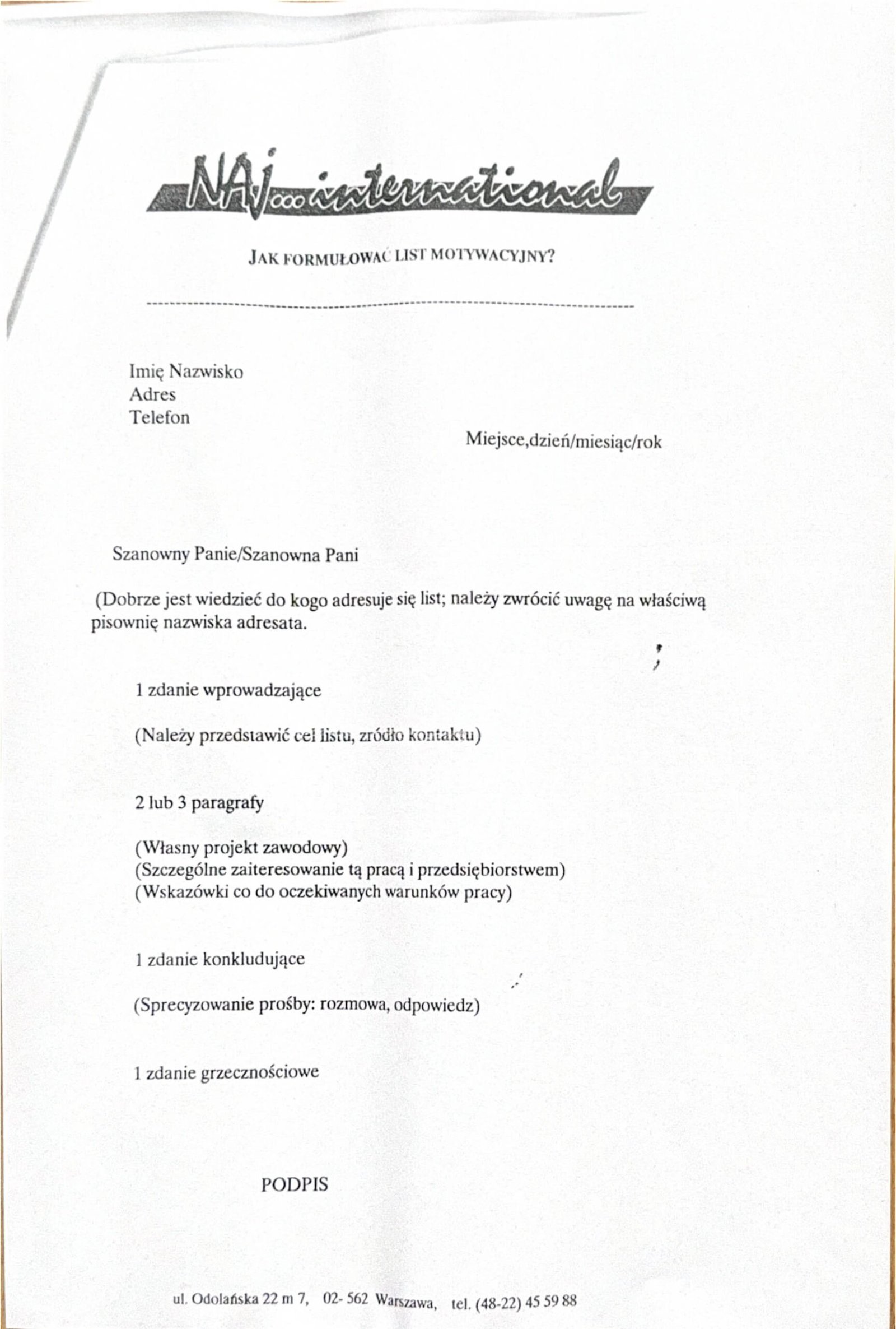
What did an application letter look like in the early 1990s?

At the beginning of the Polish headhunting market, the letter was a formal document and evidence of professional awareness. It was not enough to write that the candidate enjoyed working with people and learned quickly. Candidates were expected to present their own career idea, explain the value they could bring to the company and clearly ask for a meeting.

An archival NAJ International template from that period shows this logic very clearly. The document began with the candidate’s details, the date and a salutation addressed to a specific person. It then included one introductory sentence, two or three paragraphs of explanation, a concluding sentence with a specific request and a signature.

Archival NAJ International template showing a cover letter structure: candidate details, opening, main paragraphs, closing and signature.
This archival NAJ International document shows how a cover letter was structured, from candidate details and the purpose of contact to the main paragraphs, closing and signature.
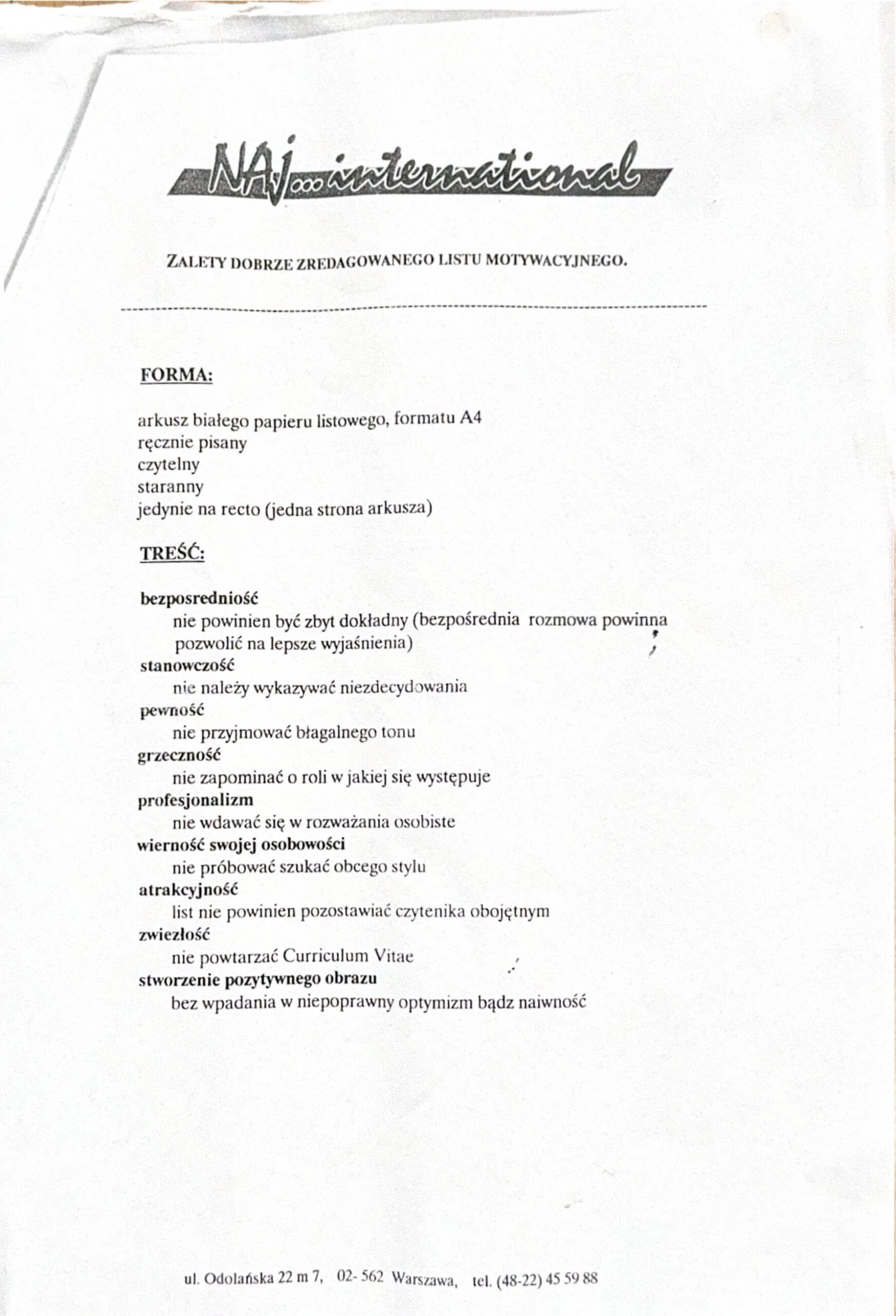
Archival NAJ International guide to a well-written cover letter, covering format, tone, clarity, concision and professional style.
This archival NAJ International document presents the qualities associated with a well-prepared cover letter, from clear formatting to directness, concision and professionalism.

Interestingly, the old format was not excessively long. On the contrary, it required discipline. The candidate had to explain the purpose of the contact, demonstrate value to the organisation and define the expected next step.

Why did handwriting matter?

At NAJ International, we treated handwriting as an additional source of information about a candidate. Therefore, we often asked candidates to prepare the document by hand and passed the sample on for graphological analysis.

Today, this may sound like a mixture of recruitment and fortune-telling. However, in the 1990s, the approach had its supporters. Handwriting was believed to reveal personality traits, working style, resilience under pressure and even relationships with other people. Naturally, some people rejected these claims.

Still, there is no reason to judge past practices with a sense of superiority. Every period uses the tools it trusts at the time. Only experience and observation show which methods genuinely support better decisions.

What did a cover letter reveal about a candidate?

In the past, the content was not the only thing that mattered. The care taken in preparing the entire document was also important. The page layout, form of address and signature indicated whether the candidate understood the principles of professional communication.

The archival NAJ template did not encourage unsupported self-praise. Instead, it recommended describing the candidate’s career idea and the specific benefits they could bring to the department and the company.

Candidates were not expected merely to explain who they were. They had to show why the company should invite them to a meeting.

During the early years of the executive search market, access to information was limited. There were no professional profiles updated in real time, no portfolios available through a single link and no range of digital communication channels.

One document therefore performed the role now divided among a CV, LinkedIn profile, message to a consultant and initial interview.

How did the internet change application documents?

The internet made applications easier to send, but it also reduced the value of many letters. Once a document could be copied, the company name changed and the same text sent many times, a personal declaration quickly became a standard attachment.

Ready-made templates appeared. With them came sentences about dynamic environments, new challenges and the ability to work both independently and as part of a team.

Candidates began to sound remarkably similar, although each of them claimed to be unique.

At the same time, professional CVs became more specific. They started to show achievements, the scale of responsibility and measurable results. It is therefore worth reviewing the guide to writing a professional CV at different career levels: Professional CV for Different Career Stages

The more information a well-prepared professional profile provides, the less reason there is to repeat the same points in an additional document.

What did LinkedIn and AI do to application letters?

LinkedIn moved career stories into the public space, while AI now helps us create many types of text. Today, a candidate can generate a polished statement tailored to a job advertisement within minutes.

The problem is that the recruiter also knows how easily it can be produced.

This does not mean that AI tools are useless. They can help organise arguments, shorten the text and remove awkward wording. However, they should not invent someone’s motivation.

When it is still unclear why a candidate wants a particular role after reading the document, technical correctness cannot save it.

For senior executives, the consistency of the full career narrative now matters more. A CV, professional profile, interview style and reasons for making a change should all tell the same story.

The guide on how to write an effective C-level executive CV may also be helpful: How to Write an Effective C-Level Manager CV

Recruiting for a key position?

A well-structured search process helps you assess not only a candidate’s experience, but also their motivation and the reasoning behind their career decisions. We can discuss how to define the right criteria for your specific role.konkretnej roli.
Contact us

When does such a document still make sense?

An additional text is useful when it explains a decision that cannot be understood from the employment history alone. It may concern a change of industry, a return to the job market, relocation or a move from a corporation to a family-owned company.

Sometimes it also helps explain the conscious decision to accept a position with a smaller scope of responsibility. On a CV, this may look like a step backwards. In reality, it can be a move towards a better fit, greater influence or a different model of professional life.

In such situations, a cover letter should not read like a school essay. Three elements are enough. First, the candidate should explain why the role is of interest. Next, they should connect their experience with the company’s challenge. Finally, they should show why the change is logical at this particular moment.

A short, personalised message to a consultant can also work well. Sometimes four specific sentences are more convincing than a full page of carefully polished declarations.

Authenticity does not mean writing without preparation. It means using arguments that could not be sent unchanged to any company.

Summary

A cover letter can still be useful, but only as a source of specific information. It may take the form of a message to a consultant, sent by email or through another communication channel. When it is sincere and meaningful, it has a chance to attract the recipient’s attention.

Most importantly, it should answer three questions: why this candidate, why this organisation and why now? It must sound like the voice of a person who understands their own career decision.

Is it worth writing one? Yes, in justified situations, preferably as a direct message addressed to a specific person.

Assessing C-Level Leadership Qualifications

The competencies of a C-level manager include both strong professional skills and an awareness of their strengths, which requires a thorough self-assessment. Understanding your key skills is essential to creating an effective CV and planning your professional development. It is worth considering how to precisely identify those competencies that will not only impress recruiters but also align with the demands of the new position and future career challenges.

Why is Qualification Assessment Important?

Qualification assessment is a key step in conscious career management. It helps you better understand your strengths and determine which competencies have the greatest impact on your professional success. For leaders at the managerial and C-level, both technical and leadership skills are important. However, in different professional situations, different managerial competencies may gain significance.

How to Identify Your Strengths?

Effective identification of strengths and competencies requires the use of modern self-assessment tools. Contemporary technologies, such as personality tests and competency analyses, allow for an accurate assessment of talents, work styles, and professional motivations. These tools help understand which skills are crucial for career development.

Self-Assessment Tools. Competencies of a C-level Manager.

Here are some popular tools for assessing qualifications and self-evaluation that can help precisely identify strengths and managerial skills:

  • CliftonStrengths (Gallup StrengthsFinder) – Gallup’s test identifies 34 key talents, helping to understand where you achieve the best results. Key talents include, among others, “Analytical Abilities,” “Relationship Building,” and “Leadership.” The basic version allows for the identification of the top five talents, but for a fuller picture, especially after the age of 24, it is worth taking the full version of the test.
  • DISC D3 Analysis – The DISC D3 tool examines behavior styles such as Dominance, Influence, Steadiness, and Conscientiousness. It also considers motivations and values, which help better understand communication and management styles. At Naj International, we successfully use DISC D3 analysis in the recruitment process for high managerial positions, which is appreciated by both clients and candidates.
  • 360-degree Assessment – A method of gathering feedback from colleagues, supervisors, and subordinates that allows for a comprehensive evaluation of competencies. Particularly useful for leaders, this method helps identify strengths and weaknesses, providing a fuller picture of leadership skills and areas requiring development.
  • Hogan Assessments – Hogan tests focus on key personality traits in a professional environment, such as ambition, emotional stability, and motivation. They can help understand management style, team leadership predispositions, and coping with stress, which is particularly important for individuals in leadership positions.

How to Use Self-Assessment Results?

Tailoring Your CV to Test Results

After conducting a self-assessment, it is worth incorporating its results into your CV. You can use them in three key sections.

1. “Professional Summary” Section (“Professional Profile”)

In this section, you can briefly present how your talents, strengths, and professional competencies contribute to your career successes. Self-assessment results can help formulate more precise and convincing descriptions of your skills, which are crucial for further career development.

  • Gallup CliftonStrengths: If the test revealed the talent “Strategist,” highlighting your ability to anticipate future challenges and create effective plans, you can phrase it as follows:
    ‘Experienced and results-oriented Chief Operating Officer with 15 years of international experience in managing operations and implementing strategic technology solutions. Effectively anticipates future market challenges by developing and implementing action plans to increase operational efficiency and profitability in organisations in European and US markets.’
  • DISC D3: If the DISC analysis indicated the “Influence” style, emphasizing your ability to build relationships and inspire a team, as well as “Conscientiousness,” related to organization and precision, you could present it like this:
    ‘Leader effective in building relationships and inspiring teams, while being well-organized and precise in task execution.”‘Team leader with 12 years of experience in international project management. Effective at building relationships and inspiring teams to achieve their goals. Precise in organising work and delivering projects to the highest quality standards, resulting in a 20% increase in productivity over the last three years.’
2. “Professional Experience” Section

In this section, you can highlight your professional achievements in the context of personality tests and self-assessment results. These results can help organize the description of achievements and effectively present your key skills. Well-described professional competencies can significantly enhance the attractiveness of your CV in the eyes of recruiters.

  • CliftonStrengths: If the test indicated talents such as “Analytical Abilities” and “Arranger,” you could express it this way:
    “Optimized business processes, contributing to a 15% increase in company savings.”
  • DISC D3: If the DISC analysis result indicated the “Dominance” style, characterized by making quick and key operational decisions, you could present it like this:
    “Managed a team of 50 people, leading to a 15% increase in efficiency.”
3. Strengthening the Soft Skills Section

Soft skills, though harder to prove, are just as important as hard competencies. The results of psychometric tests, such as Hogan or DISC, can help in the precise description of these skills in the CV.

  • Hogan Assessments: If the test results indicate your ability to manage stress and make effective decisions in difficult situations, this competency could be described as:
    “Managed a team during a crisis, resulting in a 15% increase in efficiency.”
  • DISC D3: If the test indicated the “Steadiness” style, related to creating a stable work environment and high team retention, it can be phrased like this:
    “Maintained team retention at 95% over two years, ensuring operational stability and employee satisfaction.”

All these examples allow for effective use of personality test results in creating a professional CV tailored to the job position. A precise description of skills and achievements will make your CV more credible and attractive to recruiters, highlighting your value as a leader.

Key Skills at the Managerial Level

It is important to understand that at different stages of a career, different skills and experiences gain importance. At the C-level, three main managerial skills are particularly important:

  1. Leadership and Team Management – At the C-level, the ability to effectively manage a team is essential. It is worth emphasizing experience related to leading teams, introducing new organizational structures, or managing change.
  2. Strategic Planning – This is a skill that often determines the effectiveness of a leader. C-level recruiters expect candidates to have the ability to think long-term, identify key business goals, and develop strategies for achieving them.
  3. Risk Management – In a rapidly changing business environment, the ability to anticipate threats and manage risk effectively is invaluable. It is worth highlighting experience related to identifying potential risks and taking appropriate preventive actions.

Conclusion

Career management at the C-level requires a deep understanding of your strengths and the conscious use of them in the recruitment process. Tools like CliftonStrengths, DISC D3, and Hogan Assessments allow for the precise identification of talents and provide valuable insights that can be effectively used in creating a tailored CV and in the recruitment process. It is important to always adapt your CV to the specifics of the position you are applying for. These tests not only help you assess whether the position matches your skills but also enable a better understanding of the value you bring to the organization, making it easier to effectively present key competencies. Consulting the results of these tests with HR experts or coaches can help optimally adjust your competencies to the demands of the modern job market.

Ewa Borek

How to write an effective C-level manager CV?

Writing a CV for a C-level position requires particular attention to quality and professionalism, as this document is crucial to your top-level career. Your CV should differ from your LinkedIn profile and be tailored to the specific position you are applying for. As a C-level manager, you have a wealth of experience in many areas, but not everything needs to be written about in detail. It is important to highlight those competencies that are sought after by your new employer.

Remember to include the following mandatory sections in your CV:

– Contact information

– Professional summary

– Work experience

– Education

– Skills and competences

Your CV should be concise and cover only the most relevant information. Focus on the most important experience relevant to the position. Remember that your CV will be viewed by sourcers, recruiters, future bosses (who don’t have time to read long documents) and ATSs (Applicant Tracking System). Make sure your CV is short, succinct and targeted to the right audience.

1. Choose the right CV format

The best format for a C-level CV is reverse chronological, which highlights your most recent and relevant experience. Avoid functional formats that focus solely on skills, as recruiters want to see concrete evidence of your achievements. Remember to make your CV easy to read and properly formatted so that both the recruiter and the ATS can quickly find the information they need.

Avoid a complicated or flashy design. Don’t add images or logos of previous employers or tables of any kind, as these are unnecessary and can hinder readability. In Poland, CVs with a photo are accepted and often better perceived, but remember to keep it professional.

2. Add contact details

Your contact details should be complete and placed at the top of your CV. Make sure they include:

– Full name

– Telephone number

– Location (city, province, postcode)

– Email address

You do not need to include your exact address. Avoid adding links to unprofessional social media profiles, but consider adding a link to a properly built profile on LinkedIn. Did you know that you can also add your CV in pdf format on this platform?

3. Define your professional headline

Your professional headline should be short, precise and consist of three to five words describing your professional role, e.g. ‘Experienced Commercial Managing Director’. Avoid vague titles such as ‘Experienced and results-oriented Manager’, which are too general and do not convey the specifics of your role or C-level responsibilities. This type of title also does not indicate what area of management you focus on. A better approach would be to be more specific, such as ‘COO – Vice President of Operations – Restructuring Expert’, which clearly identifies your skills and level of responsibility.

A well-constructed headline is your first opportunity to make an impression and highlight who you are as a professional. It should attract attention and help recruiters quickly understand what position is right for you.

4. Write a professional summary

A professional summary should consist of a few concise lines that outline your key qualifications, skills and achievements. Instead of writing a career objective, focus on creating a strong summary that clearly states your value.

Example: ‘Experienced and results-oriented Commercial Managing Director with 19 years of international experience (Europe, Central Asia, North and South America) in strategy and business development, sales and marketing. Managed and developed culturally diverse teams (from 12 to 50 people) in 10 countries, gaining experience in the B2B technical sector and the construction chemicals industry. Responsible for managing P&L for business worth over €100m, implementing product innovations and business models.’

5. Enter key skills and keywords

In order to accurately assess your competences and identify your key skills and strengths, it is useful to focus on analysing your own experiences. Remember that your CV is viewed by both recruiters and ATSs, so it is important to include relevant keywords such as ‘team management’, ‘strategic planning’, ‘process optimisation’, ‘risk management’ or relating to specific skills like ‘Black Belt’, ‘Six Sigma’, ‘Lean Manufacturing’ etc.

6. Describe your professional experience

When writing your work experience section, tailor it to the specific job offer to highlight the most relevant experiences and achievements. Use 5-10 bullet points for each position. Focus on strong action verbs and numerical specifics, e.g. ‘Increased revenue by 15% by implementing new sales strategies’. Your work experience should be described in a way that shows your achievements, not just your responsibilities.

Increasingly, the trend in CVs is to include a concise description of the company right next to or below its name, as well as the role under the job title. Such a description might include information about the size of your staff, budget or circumstances of your role, such as ‘Responsible for managing a £20m marketing budget for a national retailer’.

It is worth remembering to tailor your CV to the career level you are currently at, in order to better match the content to the expectations of recruiters. As your career progresses, the way you describe your work experience should evolve. At higher positions, the emphasis should shift from day-to-day responsibilities to achievements that have had a significant impact on the organisation. Such information is key for recruiters looking for C-level leaders.

Here is a sample experience description:

ABC company – international manufacturing company in the construction industry                         (from 01.2019)

Business Unit Director, Division Windows & Doors

Global role focused on transforming the window and door insulation segment and delivering business results through market development and product innovation.

– Managed the full product lifecycle, implementing innovations that increased market share by 20% in key regions.

– Developed markets in Central and Eastern Europe, Spain, Italy, the US and Brazil, contributing to revenue growth of 15%.

– Effectively managed an international team, leading to operational efficiencies of 30% and the introduction of new management structures in 10 countries.

– Was responsible for a full P&L with turnover in excess of €100m, contributing to a 25% increase in profitability.

Selected achievements:

– Executed the operational strategy for the division, which not only achieved growth targets for 2019-2020, but also achieved the highest strategy implementation score among peer divisions.

– Developed the international team, increasing its size by 30% and promoting key team members to senior positions, including leadership positions in other divisions of the company.

– Launched three innovative products that exceeded sales targets by 75% in the first year.

When describing your work experience, also remember that long tenure has its advantages and disadvantages. So it is worth considering how to present your long experience in a way that highlights your achievements and the benefits you can bring to a new employer.

7. Manage gaps in experience

If you have gaps in your employment, explain them briefly and factually. Focus on a positive message and emphasise that you are ready to return to work. You could mention consulting activities, charity work or learning new skills.

Example 1: ‘I did consulting work, supporting companies in restructuring and optimising business processes. 2020-2023.’

Example 2: ‘Parent caring for children, ready to return to the labour market. 2016-2023.’

Such a description shows that, despite the break from full-time work, you have actively used your experience and skills, which increases your attractiveness in the job market.

8. Add education, certificates and courses

List all relevant degrees, certificates and courses that have enhanced your competences and are relevant to a C-level career. Prestigious degrees such as an MBA from a reputable university are particularly important. List those qualifications that are central to the requirements of the position you are applying for. Make sure that all titles are correctly described and include dates of completion.

9. List your skills

In the skills section, focus on the competences that are key for C-level positions. List the foreign languages you speak and leadership skills such as change management, business strategy development or risk management. Also include knowledge of advanced management tools such as Balanced Scorecard or Six Sigma. Indicate specific skills that demonstrate your ability to lead an organisation in a complex, global environment or that are relevant to the position you are applying for.

10. Make sure your CV is simple and clear

Your CV should be easy to read and understand. Avoid complicated language, abbreviations and excessive decoration and tables. Focus on clarity and simplicity so that the recruiter can quickly assimilate the most important information. Remember that a CV is different from a LinkedIn profile, so ensure that both documents are tailored to the specifics of the medium.

11. Proofreading and final touches

Before submitting your CV, review it carefully to eliminate spelling, grammar and stylistic errors. Attention to detail shows your professionalism and respect for the recruiter’s time. A well-written and carefully prepared CV can significantly increase your chances of making a positive impression, whereas carelessness in this area can lead to a negative assessment of your application, especially if you are not the only candidate for the position. Ask someone to read your CV and provide feedback.

Understanding the trends in the C-level job market is key to creating a CV that will make you stand out from the competition and help you win your dream job. I hope this guide will help you prepare an effective CV. Our e-book with expanded information and examples is coming soon, so keep an eye on our profile on LinkedIn.

In the meantime, it’s also a good idea to understand what qualities and qualifications define the ideal candidate for Executive Search, and what the mutual expectations of candidates and Executive Search consultants are, in order to better prepare for the top-level recruitment process.

Remember that your CV is your professional business card. Preparing it in a professional manner and in accordance with the above principles will increase your chances of getting your dream C-level position.

Ewa Borek


Professional CV for Different Career Stages

A professional CV should change as your career develops. An entry-level candidate, a specialist, a mid-level manager and a C-level executive all need to present different evidence of value.

In 2026, recruiters still look for clarity, relevance and measurable achievements. Therefore, a strong CV is not a list of responsibilities. It is a concise business document that shows potential, results and career direction.


What should a professional CV show at the beginning of a career?

At the beginning of a career, the strongest elements are potential, direction and first signs of responsibility. Limited professional experience is not a weakness if the candidate can show projects, internships, academic work and relevant skills clearly.

Many people entering the job market worry that they “do not have enough to include”. However, recruiters do not expect a long career history at this stage. They look for signs that the candidate learns quickly, understands the role and can translate study experience into practical value.

Key elements at entry level

It is worth focusing on four elements:

  • Career objective: a short statement at the top of the CV shows what you are looking for and what direction interests you.
  • Education and projects: at the beginning of a career, this is often the strongest part of the document.
  • Internships and placements: even short experience can prove early responsibility.
  • Soft and technical skills: select the skills that match the job posting, not every skill you have.

Example of a career objective:

“I am a project management graduate looking for my first role where I can develop skills in documentation management, cross-cultural communication and administrative process support.”

How to describe education and first experience

In the education section, do not stop at the name of the university. The topic of your thesis, academic projects and practical assignments can show relevance to the role.

Example:

  • Education: Warsaw School of Economics, Management and Administration, 2020–2023.
  • Thesis: “Analysis of Contract Management in the Biotech Sector Based on the Polish Market Example”.
  • Academic project: analysis of international contract management practices, with a focus on risk, deadlines and document flow.
  • University activity: co-organization of an academic event, including schedule coordination and formal communication between teams.

If you have completed an internship or placement, avoid describing it only by job title. Instead, show what you did and what changed because of your work.

Example:

Administrative Assistant
XYZ Solutions LLC, 2025, 3 months

  • Prepared documentation in Polish and English, which improved communication between departments.
  • Supported supplier onboarding by checking documents against internal procedures.
  • Coordinated information flow between administration, legal and operations teams.

This type of description is simple, but specific. Moreover, it shows not only tasks, but also the way the candidate worked.

Why does a professional CV for a specialist need evidence?

At specialist level, recruiters look for results, scope of responsibility and fit with the role. They no longer want to know only where you worked. Instead, they want to understand what you improved, implemented or organized.

A concise professional summary is a good starting point. It should indicate your area of specialization, industry experience and one strong achievement.

Example:

“Logistics Specialist with 5 years of experience in supply chain optimization in the FMCG sector. Reduced transportation costs by 15% by implementing a new planning system. Looking for a role in an international environment.”

When describing experience, change the perspective from duties to achievements. This is one of the most common differences between an average CV and an effective CV.

Less effective example:

  • Responsible for warehouse management.
  • Supported supplier cooperation.
  • Prepared reports.

Stronger example:

  • Increased warehouse operational efficiency by 20% by implementing a WMS system.
  • Reduced delivery handling time by 15% after reorganizing the inbound schedule.
  • Introduced recurring KPI reporting, which improved control over delivery punctuality.

The difference is clear. First, the weaker version says what the candidate was responsible for. By contrast, the stronger version shows the impact of their work on the organization.

At this career stage, certifications, tools and training also matter. If the job posting mentions Six Sigma, SAP, Power BI, Excel, CRM or industry systems, check whether you can naturally include them in your professional resume.

The most useful elements are usually:

  • industry certifications, when they are recognized in your field,
  • technical tools, especially when they appear in the role requirements,
  • specialist training, because it supports your professional direction,
  • specific working methods, such as Lean, Agile, Six Sigma or project management.

As a result, your CV becomes easier to find in candidate databases and easier for the recruiter to understand quickly.

What matters in a mid-level manager CV?

A mid-level manager CV should show scale of responsibility and impact on team or business results. At this stage, the job title alone is not enough because recruiters look for evidence of leadership.

In the professional summary, show what teams, processes and budgets you managed. Keywords from the job posting can help, such as “process optimization”, “team management”, “automation”, “transformation” or “change management”. However, each keyword should be supported by facts.

In a mid-level manager CV, the most important elements are:

  • team scale: how many people were under your responsibility,
  • process scope: what area you managed,
  • budget or result: what financial or business responsibility you had,
  • change or improvement: what you actually improved,
  • people development: how you supported your team and built work standards.

Example:

“Managed a team of 50 people, resulting in a 25% productivity increase. Implemented a KPI system that streamlined reporting in a company with PLN 50 million in revenue.”

This sentence works because it combines three elements: team scale, a specific result and impact on management practice. As a result, the recruiter can understand the scale of responsibility faster.

You can also describe experience in bullet points:

  • Increased team productivity by 25% by introducing daily operational briefings and clear KPIs.
  • Reduced department turnover by 12% by improving the onboarding process for new employees.
  • Managed an operational budget of PLN 10 million, keeping costs within the approved limit.
  • Led the team through a structural change, maintaining continuity of work and project deadlines.

Do not omit your management style. If you developed people, conducted development conversations, implemented work standards or built a culture of accountability, say it directly. In managerial roles, leadership skills are often as important as financial results.

You may also like: C-level manager competencies

How should a C-level executive write a CV?

A C-level executive CV should show strategic responsibility, organizational impact and international context. At this level, the document should not read like an extended list of operational projects.

An executive candidate should show not only what they managed, but also what decisions they made and what those decisions changed in the organization. Therefore, the professional summary should show direction, scale and result.

Example:

“Experienced COO with 15 years in the technology sector. Managed teams across 10 countries, led digital transformations and reduced operational costs by 30%. Looking for another executive role in an international environment.”

At this level, the most important elements are:

  • strategy and transformation: restructurings, mergers, expansions and operating model changes,
  • business result: profitability growth, cost reduction, revenue growth and EBITDA improvement,
  • international context: multi-country structures, HQ cooperation and cross-border projects,
  • stakeholder cooperation: board, supervisory board, owners and investors,
  • decision-making: strategic recommendations, growth scenarios and risk management.

Example of an achievement description:

  • Led an operational restructuring that increased profitability by 40% and enabled expansion into three new European markets.
  • Managed digital transformation across 10 countries, standardizing reporting processes and reducing operational costs by 30%.
  • Prepared recommendations for the board and supervisory board, covering budget, ROI, EBITDA and investment scenarios.

At C-level, strategic communication is also critical. If you presented data to the board, investors or a supervisory board, include it. This shows that you do not only produce data, but also draw conclusions and support decisions.

You can read more about preparing a document for the highest management level in How to write an effective C-level manager resume?

Why does CV personalization improve interview chances?

CV personalization means adjusting the emphasis to a specific role, not rewriting the entire document from scratch every time. It is one of the simplest ways to increase your chances of being invited to an interview.

Start by reading the job posting and checking the language the employer uses. If it includes terms such as “digital transformation”, “leadership”, “change management” or “process optimization”, consider whether you have real examples that prove these competencies. Then include them in the summary, experience section or achievements.

A good working method looks like this:

  • Step 1: mark the requirements that appear several times in the job posting.
  • Step 2: choose 3–5 elements that genuinely match your experience.
  • Step 3: add specific examples, numbers or outcomes.
  • Step 4: remove information that does not support this specific application.
  • Step 5: check whether the most important points are visible in the first part of the document.

Example:

If the job posting mentions “change management”, do not add this phrase only to the skills section. Show it in context instead:

“Led an 80-person team through a change in the working model, maintaining project deadlines and reducing turnover during the transformation period.”

This version is stronger because it connects a competency with a business situation and an outcome. Therefore, it is more credible than a keyword added only to the skills section.

At the same time, avoid empty keyword copying. Recruiters quickly notice a document that sounds like a mechanically adjusted list of phrases. Therefore, each keyword should be connected with a fact, number or practical example.

In 2026, readability also matters. Recruiters often scan CVs quickly, so the most important information should be visible immediately. A short summary, concrete achievements and clear section structure work best.

You may also like: C-level executive recruitment trends

Conclusion

A well-prepared professional CV shows the right information at the right career stage. An entry-level candidate should emphasize potential, a specialist should show specific results, a manager should demonstrate scale of responsibility, and a C-level executive should show strategic impact.

In practice, even small changes in how you present achievements can increase your chances of getting an interview. Before sending your document, therefore, check whether it shows not only your career history, but also your value for a specific organization.

Ask yourself three simple questions:

  • Does my CV show concrete evidence, or only responsibilities?
  • Are my most important achievements visible immediately?
  • Does the document fit the role I am applying for?

If the answer to any of these questions is “no”, it is worth improving the document before sending it. Sometimes one well-written achievement says more than a long list of tasks.

If you are planning a career move in 2026, treat your CV as a decision-support tool. It should help the recruiter quickly understand who you are, what you can do and why it is worth inviting you to an interview.

Author: Ewa Borek
Senior Search Consultant

Published: January 2025
Updated: June 2026

How do we react to long and very long employment in one company?

One of the most important aspects that catches the attention of recruiters is the length of tenure in one company. Is long-term employment in one place an asset, or could it be a cause for concern? By long, I mean several years, even 20 or more. Let’s think about it.

It should be emphasized right away that long tenure in one company in one role is different from changes in positions, promotions, and expanding skills and responsibilities. Therefore, our role as recruiters to be able to distinguish and demonstrate this to the client.

Long tenures were more common in previous years. We were taught that constant job changes look bad on a CV and take away our chance for a good job, so we often built our tenures to be our strength. However, it seems that those entering the job market now see it differently.

Why can long tenure be beneficial?

  • Good knowledge of the company, industry, products, services, clients, and competition.
  • Contacts in the market and industry.
  • The possibility of acting as an expert.
  • The ability to adapt to changes in the company, successive restructurings, and optimizations.
  • Loyalty and stability.
  • Self-motivation.

Why can long tenure be limiting?

  • Walking the beaten path.
  • Resting on laurels – meaning once you have to earn your reputation, then like in school, subsequent teachers see your good grades in the diary.
  • Lack of knowledge of various professional environments and work cultures. Particularly severe if we settle immediately in the first job.
  • Resistance to change.
  • Burnout.
  • Fear of the risk of going to a new job, e.g., getting stuck in a golden cage.
  • Concerns of headhunters and potential employers that a person with a long tenure will withdraw from the process at the last minute.
  • Employer concerns about whether a long-term employee from another company will be able to “switch” to new tracks.
  • Often, the next tenure after a long employment is short, a few months, a year. This is based on my observations in practice.

Based on the recruitment conducted over the past year, I can conclude that longer tenure is not well-received in sales positions.  Clients fear the “fat cat” syndrome. Such a person may only visit friendly clients and may not want to make an effort to acquire new ones. But I have also encountered the opinion of the client that the constant need to acquire new customers is very exploitative. And it is worth giving such an employee other aims or transferring them to other positions. Longer tenure, on the other hand, is more appreciated in financial positions, where loyalty and stability are significant assets.

Regarding the cultural approach associated with national traditions, long and very long tenure is an asset for Scandinavian companies. In addition, this applies to various positions, including sales.

Summing up

In summary, long tenure in one company is neither exclusively an asset nor just a limitation. The key is an individual approach to evaluating the candidate. Both acquired skills and the potential for growth in a new environment can be valued. It is worth approaching such candidates with openness. Appreciating the value of their previous experience while also evaluating their flexibility and approach to new challenges. Also chances of adaptation in a new, often more competitive environment. It is worth remembering that each case is unique, and long and very long employment can be interpreted differently depending on the context.

However, it happens that I hear from a client: She has been there for 20 years? She is already unreformable!

Or from a candidate: What’s 5 years of tenure? He hasn’t even gotten to know the organization well yet!

I’m curious about your opinion…

Dorota Wróblewska, Senior Project Manager, d.wroblewska@naj.com.pl

You may be also interested in: How to give yourself „career insurance” during uncertain times? Four Tips.

Becoming CEO. 7 Tips.

From Business to Cultural Institutions? Is the migration of candidates between the commercial sector and arts and culture institutions possible? 

The Polish arts and culture scene is currently undergoing an intense process of change, facing new new challenges in almost every area of its activities. At the same time, it opens up fascinating possibilities in various fields such as digitization, hybrid culture and artificial intelligence. Over the past few years, while conducting recruitment processes for this market segment (Museums, Foundations), I had the opportunity to listen to the diversity of experiences, attitudes and opinions of people associated with this environment.

From my experience, it appears that there is a growing interest in this sector, both from society and potential  employees, including those from the commercial industry. Therefore, recruiters are faced with the task of creatively  supporting this process for both employers and prospective employees.

One of the challenges in the world of NGOs is the issue of how to attract and retain new employees who would bring new quality and mutual benefits through collaboration? 

  1. Certainly, the key to success lies in utilizing a variety of recruitment tools and understanding mutual diversity
  2. As well as reaching out to candidates from the commercial industry, as perhaps an unconventional idea for acquiring new employees

However, will such a diverse relationship ( a candidate from Business and a Cultural Institution) have a chance for a successful marriage? 

It turns out that indeed it has a high chance of sussess, but it requires good preparation and mutual understanding of the needs of both parties. Therefore, dialogue with the client and building a trustworthy relationship with them are crucial to best understand their environment better and fulfilling their requirements more effectively. My role is to inform the client about the market’s realities and fully meet their needs. My task is to show the client the realities of the market but also to open up and propose new solutions. Building such a relationship brings benefits to everyone involved.

The attractiveness of Cultural and Art Institution goes beyond just their “mission”. They are places that offer creative freedom and community engagement. These places are becoming increasingly desirable for the modern candidate due to changing expectations regarding the meaning of work and its place in our lives.

From business to Cultural Institutions?

More and more consciously, we want to maintain a balance in our lives, where work becomes not only a duty, but also a space that respects our values, passions, and leisure time. We don’t want to be just cogs in a big machine, we want to feel that our private life extends beyond weekends and quick vacations. This trend is gaining stronger traction in our society, and I have the impression that nothing will stop these changes.

And here arises the question, how to bridge both worlds to attract and retain new employees while gaining new inspiring perspectives and fostering the development of the organization itself? Both of these worlds have their personalities, but there are various opinions and perceptions about them that may not always reflect reality.

The transition from the private sector to Cultural Institutions might seem like an intergalactic journey, accessible only to the bold or desperate. However, this does not mean that such a transfer cannot to be successful. The mutual attractiveness of these two worlds is intriguing enough to be worth trying; and the collision with realities can be softened through honest and fair recruitment discussions.

Culture and Art Institutions in Poland, often struggle with the opinion that:

  • they are politically conditioned, which affects their image as insecure workplaces
  • and lack of competent people within the organization.
  • added to this are low salaries, which are an additional barrier, making it difficult to attract high-class professionals.

These are the main ills of these organizations, which hinder development and innovation.

Fortunately, there are some on the Polish market that escape this trend. These organizations are already beginning to function in line with modern, international institutions, which, also supported by the State, are capable of making innovative decisions, while maintaining their mission and autonomy.

Institutions of Culture and Art in Poland often grapple with the perception that:

  • they are politically influenced, affecting their image as uncertain workplaces
  • a lack of competent of proactive individuals within the organization
  • an additional barrier is low salaries, making it challenging to attract high-caliber specialists

These are the main challenges for these organizations that hinder their development and innovation. Fortunately, there are starting to operate on a level comparable to modern, international institutions capable of making innovative decisions while preserving their mission and autonomy.

It seems to me that in the majority of the well-known Cultural and Art Institutions, there is a lack of?

  • A unified management strategy 
  • A consistent organizational culture 
  • Efficient leadership personnel

The lack of a coherent management strategy and a shortage of soft HR specialists generate organizations that are rigid, incapable of change, andthus unable to attract new potential experts from other industries.

What else could positively move the process of change forward?

  • Complex tenders, which may appear “unfriendly and biased” to individuals outside this sector, and the entire recruitment process burdened with many formalities and the required knowledge of public law from the outset
  • Recruitments often take place through contacts and recommendations from employees, which is not inherently problematic. However, often there is no overall  control or management of this process
  • There is a lack of a human resources department (soft HR) that will consciously build a cohesive organizational culture and provide support for the management. HR departments in such institutions mainly consist of specialists in Labor Law and Administration. However, all “soft” activities rely on the shoulders of department managers, who, to the best of their abilities, try to support theit team. However, they often do so intuitively and without proper preparation
  • Many times during conversations with institutional candidates, I have often observed frequent pressures from superiors or team members that approach the border of bullying. It is staggering, but paradoxically, this phenomenon seems to thrive in that environment. I believe that the migration of employees between these worlds could positively impact the decline of this shameful phenomenon.
  • Another difficulty is the fact that these organizations often operate within rigid structures, with employees “closed” to changes or unable to implement them. Quite often, these is chamging, yet they themselves still cling to established patterns. I’m not saying that everything is bad everywhere, but there is a lack of openness and dialogue on a larger scale

What else could positively impact initiating the process of change?

  • I believe that focusing on the growth of managerial competencies in this sector is crucial. I had the opportunity to participate in a personnel audit in one of such institutions, and I saw how receptive this group is to change, how the competencies of the management evolve, leading to increased awareness and belief in proactive power.
  • Another barierr encountered in Cultural and Art Institutions is the issue of low and non-competitive salaries, making it more challenging to attract experts from outside the sector. While salary is not always the sole determinant of hiring a good employee, it remains a significant limitation.
  • Undoubtedly, a positive aspect that should be emphasized as a strength of Cultural and Art Institutions is their openness to hiring mature candidates (Silvers). They adeptly bridge generations – something the commercial market should take note of.

And what does the commercial market say about such a transition in the opposite direction ( from Cultural Institution to Business)?

From my experiences, it appears that the commercial sector is unfortunately not as “welcoming” to individuals who have previously worked on the public isector side. It seems that this transition is less feasible. Typically, candidates enter these organizationall structures through and referrals from individuals they had the opportunity to collaborate with externally. There is a belief that employees from non-governmental institutions may struggle in a dynamic and competitive environment. On the other hand, for candidates from the private sector, public institutions seem very attractive. They see greater opportunities for realizing their ideas, pursuing values, and unlimited creativity compared to their current environment our role, as recruiters is crucial in honestly and fairly confronting candidates with their expectations and perception can result in unpleasant. 

Fortunately, there are already Cultural and Art Institutions that consciously manage human potential, build cohesive organization, and are open to development. These are institutions that are aware that, to survive and compete with European cultural giants, they should boldly define new rules of the game, create modern workplaces, and become a source of inspiration for the entire society and future employees. 

The key to their mutual relationship is open dialogue and understanding the needs of both sides. By combining a variety of recruitment tools, we can build a solid bridge that allows for the seamless migration of candidates. However, all of this requires honest conversation, mutual readiness for adaptation, and the construction of trustworthy relationships. This  kind of collaboration can bring mutual benefits, but as I mentioned earlier, it will require careful preparation and understanding of each other’s  specificities. This jont effort, towards attracting new talents, can bring a fresh perspective, innovations, and mutual advanteges. I believe that combining the competencies of these two entities is possible and highly valuable, where professional fulfillment and a sense of realizing one’s values and ambitions are entirely achievable. as real as possible.

Agata Kostrubiec

This may also interest you Recruitment NGOs and Cultural Institutions

How to give yourself “career insurance” during uncertain times?

In a time of so much uncertainty, many professionals feel unmoored. We can’t control the public health situation or the broader economy. But when it comes to our careers, we don’t have to sit back and wait for things to happen to us. Here are four steps every professional can take now to create their own long-term career insurance. That will help protect them—regardless of broader instability:

Develop “bridging capital”

Most professionals, unless they’re making a conscious effort, tend to build homogeneous networks. That’s fine–until it isn’t. In a downturn, you need diversity—of industry, age, skills, and background. Now is the time to start consciously seeking out diverse networks. They provide the benefit of exposing you to new ideas and methodologies. In boom times play an even more critical role during contractions, when they can yield critical market intelligence or even job leads. After all, it doesn’t help you to know 1,000 people at your company or in your industry if everyone else has also been laid off.

For instance, an executive in the travel industry will be much more professionally nimble—and has a better chance of landing a new job quickly—if she’s taken the time to develop contacts who work in countercyclical fields, such as online streaming or shipping logistics. Tapping existing contacts with diverse circles is a good starting place to build your network. For instance, you could host a virtual networking dinner with a cohost, with each of you inviting half the guests, so your social networks can cross-pollinate. This is especially useful if your cohost doesn’t work in your company or industry. (For instance, you could tap a college friend, someone from your recreational sports league, or someone you met at the dog park.)

Step into volunteer leadership vacuums

Especially during a crisis, many professionals pull back on volunteer activities since they’re worried about their paid responsibilities- careers. That’s an opportunity for you because it’s also a time when many people seek out the solace of a community. Even if your previous involvement has been minimal, you can step up and offer to run a webinar, virtual “mixer,” or skills development workshop for a company Employee Resource Group or a professional association. It’s a chance to help others and build a positive reputation in the process.

Create intellectual property

Many professionals are respected by their peers who work with them directly. But it’s rare—and valuable—to gain the respect of those who have never worked with you directly on the strength of your ideas. These days, you may not have the opportunity to speak at many in-person conferences. But you can share your expertise online by creating written content, such as blogging about industry topics on LinkedIn or offering to write for your company’s newsletter.

One frequently overlooked opportunity is sharing ideas or best practices regularly on your company’s intranet. Busy professionals sometimes view this as a distraction, but because this is often the pet project of senior leaders who hope to break down organizational silos, it’s a chance to get noticed. One friend of mine ended up in an extended personal dialogue with her CEO after replying to an intranet thread about ideas for increasing environmental sustainability at the company. The key is making your insights known to people inside and outside your company, so they remember your name and can say, “I like the way she thinks.”

Test a side project

You may love working for your company and have no desire to start a side business. Do it anyway. In a rocky economy, the more optionality you have, the better, like Pat Flynn, whom I profile in my book Entrepreneurial You. Flynn was an employee at an architectural firm who started a blog to capture his study notes as he readied himself for a professional exam around green building practices. Eventually, he created an e-book based on his articles and sold it for a modest fee on his website.

That became a lifeline for him when, in 2008, he got laid off from his firm. But since he had created a side business that actually earned him more each month than his day job, he didn’t flounder. Start small, work for free at first, and test out possibilities to see what you enjoy and whether others seem interested. At a minimum, it’ll teach you new skills you can bring back to your job. And at best, it can bring in new income and perhaps open future professional doors.

In uncertain times, we have to ask ourselves: What assets would we most want to have in the case of a prolonged downturn? And what steps can we take to obtain them today? By seizing the initiative now, you’ll have created—in small, manageable ways—” career insurance” that will see you through, regardless of how your company or industry fares moving forward.

Dorie Clark is a marketing strategy consultant who teaches at Duke University’s Fuqua School of Business and has been named one of the Top 50 business thinkers in the world by Thinkers50. She is the author of Entrepreneurial You, Reinventing You, and Stand Out.

https://www.fastcompany.com/90529474/how-to-give-yourself-career-insurance-during-uncertain-times?utm_sq=ghf9xenfnm

It can be also interesting for you Becoming CEO. 7 Tips.

We all need to get better at time management

Effective time management is crucial for success in both personal and professional realms. To master this skill, follow these essential rules.

  • Firstly, prioritise tasks based on urgency and importance. This ensures that critical activities receive immediate attention, preventing procrastination.
  • Secondly, create a detailed schedule or to-do list. Organise tasks into manageable blocks of time, allocating specific hours for work, breaks, and leisure.
  • Moreover, set realistic goals to avoid overwhelming yourself. Break larger tasks into smaller, more achievable steps, fostering a sense of accomplishment.
  • Additionally, learn to say ‘no’ when necessary. Overcommitting can lead to burnout, jeopardising the quality of your work and overall well-being.
  • Furthermore, embrace technology to enhance productivity. Utilise tools like calendars, task management apps, and reminders to stay on track and meet deadlines.
  • Moreover, practice the 2-minute rule. If a task takes less than two minutes to complete, do it immediately rather than postponing it.
  • Furthermore, allocate time for self-reflection. Regularly assess your progress, identify areas for improvement, and adjust your time management strategies accordingly.
  • Equally important is the concept of batching similar tasks. Grouping similar activities together minimizes transition time, allowing for increased focus and efficiency.
  • In addition, incorporate breaks into your schedule. Short breaks boost productivity and prevent burnout by maintaining a healthy work-life balance.
  • Lastly, be flexible and adapt to unexpected changes. Life is unpredictable, and the ability to adjust plans accordingly is a hallmark of effective time management.

In conclusion, mastering time management involves prioritization, organization, and adaptability. By following these rules, you can optimize your productivity and achieve success in various aspects of life.

It can be interesting for you Internationalization of Talent | Global Executive Search Study

Is it the right time for the internationalisation of managerial talent? Are managers open to working outside their country? Do companies open up to hiring managers from other countries due to home office more likely?

We report on a survey conducted in 17 countries at the end of 2022. In the final quarter of 2022, IESF conducted a comparative study on the perception of talent internationalization among companies and candidates. This study aims to analyze and compare how individuals view their work’s internationalisation and future prospects in this area. We try to find to answer whether local organizations are interested in international talent or if foreign companies seek out local executives and other professionals.

To gather data, IESF conducted a quantitative study using self-applied web surveys. The surveys were distributed to two groups: (A) decision-makers in relevant companies in each country and (B) candidates or professionals who are either available on the job market or already employed. The survey asked both groups similar questions to compare interests and results comprehensively.

The study’s findings and analysis, which identify several gaps and similarities in respondents’ perceptions, are presented in this report. The research included participants from various industries, including directors, C-level executives, senior managers, and professionals from different regions and countries, including both men and women. Participants from 17 countries across all four continents were included in the study.

Overall, the study provides valuable insights into the perception of talent internationalization among companies and professionals worldwide. By comparing and analyzing responses, the study sheds light on the different perspectives and priorities across various industries and regions. Is the Global Mindset a Given in the Global Context?