
A company can enter a new market faster than it could a decade ago. Leadership teams can work across several countries, specialists can collaborate remotely, and strategic decisions can be made thousands of kilometres away from the employees and customers affected by them.
Technology has reduced distance. It has not removed context.
For headquarters, this creates an execution challenge. A process that works well in one country may lose effectiveness when transferred unchanged to another. The same is true for management practices, decision rights, feedback, hiring standards and expectations around leadership.
The question is no longer whether an organisation should operate globally or locally. The real decision is where consistency creates value and where adaptation protects execution.
A global mindset in business is an execution discipline
A global mindset in business is not primarily about knowing as much as possible about different national cultures. It is the ability to recognise when experience from one market is no longer a sufficient basis for a decision.
That requires leaders to hold two perspectives at the same time.
Some standards should remain consistent. Ethics, accountability, expected business outcomes and basic leadership principles should not change every time a company crosses a border.
Other elements may need to change because they reflect the habits of headquarters rather than the conditions required to achieve the intended result.
This distinction matters because organisations are under pressure to adapt faster. Deloitte’s 2026 Global Human Capital Trends research found that 85% of leaders consider it critical to build the ability of organisations and workforces to adapt at the speed required today. Only 7% said their organisation was leading in continuously developing that capability.
Adaptability does not mean changing every rule.
It means knowing which part of the operating model should remain stable and which part has to respond to the market.
Standardise the outcome, not every step of the process
Headquarters may have a proven recruitment model, performance management process or reporting structure. That does not mean every element will produce the same result in another country.
Job titles are one example. The same title may imply a different level of authority, seniority or market value depending on the country.
The same applies to communication. A feedback style intended to create transparency may be interpreted differently across teams. A reporting structure that supports speed at headquarters may create unnecessary approval layers elsewhere.
Local employment practices, regulation, talent availability and compensation expectations can create further differences.
For that reason, the most useful question before transferring a process is not: “How do we implement our model here?”
It is: “Which parts of our model are essential to the business outcome, and which parts can change without compromising that outcome?”
This distinction protects an organisation from two opposite mistakes.
The first is assuming that a model developed at headquarters is automatically universal.
The second is treating every market as so exceptional that the organisation can no longer maintain common standards.
Neither supports scalable international execution.
Not every cross-border problem is a cultural problem
International collaboration is often explained too quickly through “cultural differences”.
Sometimes culture matters. Sometimes it is not the main issue.
A local manager may be accountable for performance but have limited authority over resources. Information may reach one country later than another. Headquarters may expect initiative while requiring approval for most decisions.
Those are operating-model problems.
A 2026 Harvard Business Review analysis of global collaboration makes the same distinction. Friction across global teams is not caused only by cultural differences. Unclear authority, weak information flows and inefficient processes can create significant barriers to collaboration.
This changes how leaders should diagnose the situation.
If every disagreement is immediately attributed to national culture, the organisation may overlook a process or governance problem that it created itself.
At the same time, cultural intelligence still matters. A study of 1,592 global virtual teams found that cultural intelligence was associated with team outcomes through its effect on conflict and conflict perception. The research suggests that cultural intelligence can support more effective collaboration, but it is better understood as the ability to navigate cultural diversity than as a catalogue of assumptions about nationalities.
For a global leader, the practical discipline is therefore diagnostic.
First establish whether the problem comes from authority, information, process or incentives. Then assess how culture and communication affect the way those systems are experienced.
AI makes local judgement more important, not less
AI makes it easier to analyse information, automate parts of work and scale solutions across countries.
That can create a tempting assumption: if a solution can be deployed globally, it should also be standardised globally.
The two are not the same.
The World Economic Forum’s Chief People Officers’ Outlook published in 2026 describes workforce strategies being reshaped simultaneously by accelerating AI adoption, geopolitical fragmentation, economic volatility and skills mismatches. It also identifies a shift from AI experimentation towards broader implementation.
This creates new decisions for international organisations.
Who remains accountable for an AI-supported decision? Where is human judgement required? Which data can be used? What assumptions were embedded in a centrally designed tool? When does local regulation or business practice require a different approach?
Culture is also part of the issue. Deloitte reports that 65% of organisations believe their culture needs to change significantly in response to the impact of AI.
Technology can make global deployment faster.
It does not remove the responsibility to test whether the solution works in the local environment.
For leaders, that is an important distinction. Technical scalability should not be confused with organisational universality.
Five decisions before transferring a model to another market
A global mindset in business becomes useful when it changes the way decisions are made.
Before transferring a management process, HR model or operating practice to another country, leadership should resolve five questions.
- 1. What business outcome are we protecting?
Separate the result from the method currently used to achieve it.
The standard may be decision quality, compliance or customer experience. The exact procedure does not always have to be identical.
- 2. Which conditions are genuinely local?
Regulation, labour-market conditions, talent availability and established business practices may require a different implementation.
A local difference is relevant when it changes the feasibility, risk or effectiveness of the decision.
- 3. Is the problem cultural or organisational?
Check roles, decision rights, information flows and accountability before explaining friction through culture.
A badly designed process does not become a cultural issue simply because the people involved work in different countries.
- 4. Who has enough local knowledge to challenge headquarters’ assumptions?
This may be a Country Manager, local HR leader, sector expert or external partner.
Their role should not be limited to implementing a decision that has already been made. Local expertise creates most value when it can influence the decision before the operating model is fixed.
- 5. Which standards remain non-negotiable?
Adaptation does not mean abandoning consistency.
Organisations still need explicit standards for ethics, accountability, quality and business outcomes. The decision is how those standards are achieved in each market.
These questions become particularly important when hiring the first senior leaders in a new country.
A Country Manager, Managing Director, Plant Manager or functional leader may be responsible not only for delivering local results. That person often becomes the practical interface between headquarters and the realities of the market.
International experience alone does not create global leadership
Working in several countries can broaden a leader’s perspective.
It does not automatically create the ability to lead effectively across markets.
Research published in the Scandinavian Journal of Management in September 2026 suggests that the relationship between international experience and global leadership potential is more complex than simple exposure to other countries. Cultural intelligence and intercultural adjustment are among the mechanisms that influence how international experience translates into leadership potential. The study also indicates that the effects are not uniform across individuals.
Experience therefore provides material for learning.
It does not guarantee learning.
A leader who has worked internationally still needs to recognise personal assumptions, test them with people who understand the market and revise a decision when new evidence appears.
That is a more useful capability than confidence based simply on the number of countries in which someone has worked.
Global leadership requires curiosity and operating discipline
International organisations need common standards.
Without them, accountability becomes fragmented and execution becomes difficult to compare.
However, rigidly exporting procedures from headquarters can create a different problem. The organisation may preserve formal consistency while weakening local effectiveness.
Global leadership therefore requires discipline on both sides.
Headquarters needs to be clear about what is genuinely non-negotiable.
Local leaders need enough authority to explain when the prescribed method creates unnecessary risk or prevents the company from achieving the intended result.
This balance becomes more important in an uncertain operating environment.
PwC’s 29th Global CEO Survey, based on responses from 4,454 CEOs across 95 countries and territories, reports increased concern about macroeconomic volatility, cyber risk and geopolitical conflict while companies continue investing in technology and business reinvention.
In this environment, headquarters cannot hold every relevant piece of information.
At the same time, local teams cannot operate as independent organisations with no common framework.
The operating model has to allow knowledge to move in both directions.
That is what makes adaptation governable rather than improvised.
A global mindset is not about making every market work the same way. It is about knowing what must remain consistent — and what must adapt for the business to succeed locally.
What does a global mindset mean in practice?
The most useful change usually happens before a decision is made.
Instead of assuming that a successful solution from one country is universal, leaders identify the conditions that made it successful.
They then test those assumptions against local knowledge.
This allows the organisation to preserve the standards that genuinely define the company while changing the method where the market requires it.
A global mindset in business is therefore less about knowing every market and more about improving the quality of decisions between markets.
The leadership choice is explicit.
Define what must remain common. Give local expertise enough influence to identify what must change. Then make accountability for the final decision clear.
That is how an international organisation can adapt without losing control and maintain standards without confusing consistency with uniformity.
FAQ
What is a global mindset in business?
A global mindset in business is the ability to make decisions across different markets while distinguishing between company-wide standards and practices that need to adapt to local conditions. It includes cultural intelligence, adaptability and the ability to test assumptions against local evidence.
Why are cultural differences not enough to explain problems in global teams?
Because friction can also result from unclear roles, weak information flows, decision rights or poorly designed processes. Leaders should examine these organisational factors before assuming that culture is the main cause.
Does AI reduce the importance of local market knowledge?
No. AI can accelerate analysis, automate work and help organisations scale solutions, but leaders still need to decide where human judgement is required, who is accountable and whether centrally designed solutions fit local regulation and business conditions.
How can headquarters balance global standards with local autonomy?
Start by defining the outcome and the standards that are genuinely non-negotiable. Then give local leaders enough authority to identify where the method needs to change. Clear decision rights make local adaptation compatible with global accountability.
Sources
Over 35 years, recruitment tools, pace and candidate expectations have changed. One thing has not. A company still wants to know why this particular person can solve a specific business problem.
What did an application letter look like in the early 1990s?
At the beginning of the Polish headhunting market, the letter was a formal document and evidence of professional awareness. It was not enough to write that the candidate enjoyed working with people and learned quickly. Candidates were expected to present their own career idea, explain the value they could bring to the company and clearly ask for a meeting.
An archival NAJ International template from that period shows this logic very clearly. The document began with the candidate’s details, the date and a salutation addressed to a specific person. It then included one introductory sentence, two or three paragraphs of explanation, a concluding sentence with a specific request and a signature.
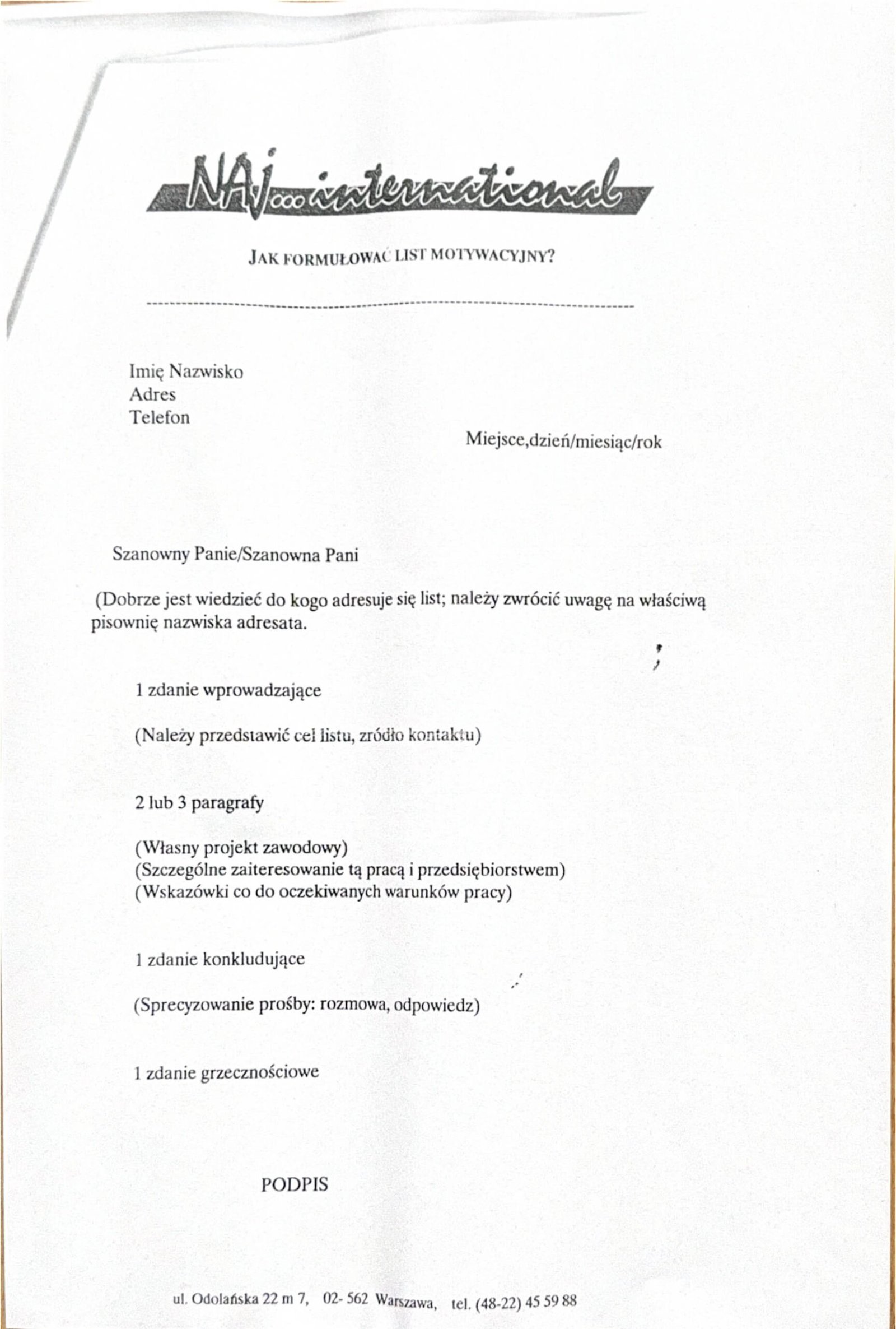
Interestingly, the old format was not excessively long. On the contrary, it required discipline. The candidate had to explain the purpose of the contact, demonstrate value to the organisation and define the expected next step.
Why did handwriting matter?
At NAJ International, we treated handwriting as an additional source of information about a candidate. Therefore, we often asked candidates to prepare the document by hand and passed the sample on for graphological analysis.
Today, this may sound like a mixture of recruitment and fortune-telling. However, in the 1990s, the approach had its supporters. Handwriting was believed to reveal personality traits, working style, resilience under pressure and even relationships with other people. Naturally, some people rejected these claims.
Still, there is no reason to judge past practices with a sense of superiority. Every period uses the tools it trusts at the time. Only experience and observation show which methods genuinely support better decisions.
What did a cover letter reveal about a candidate?
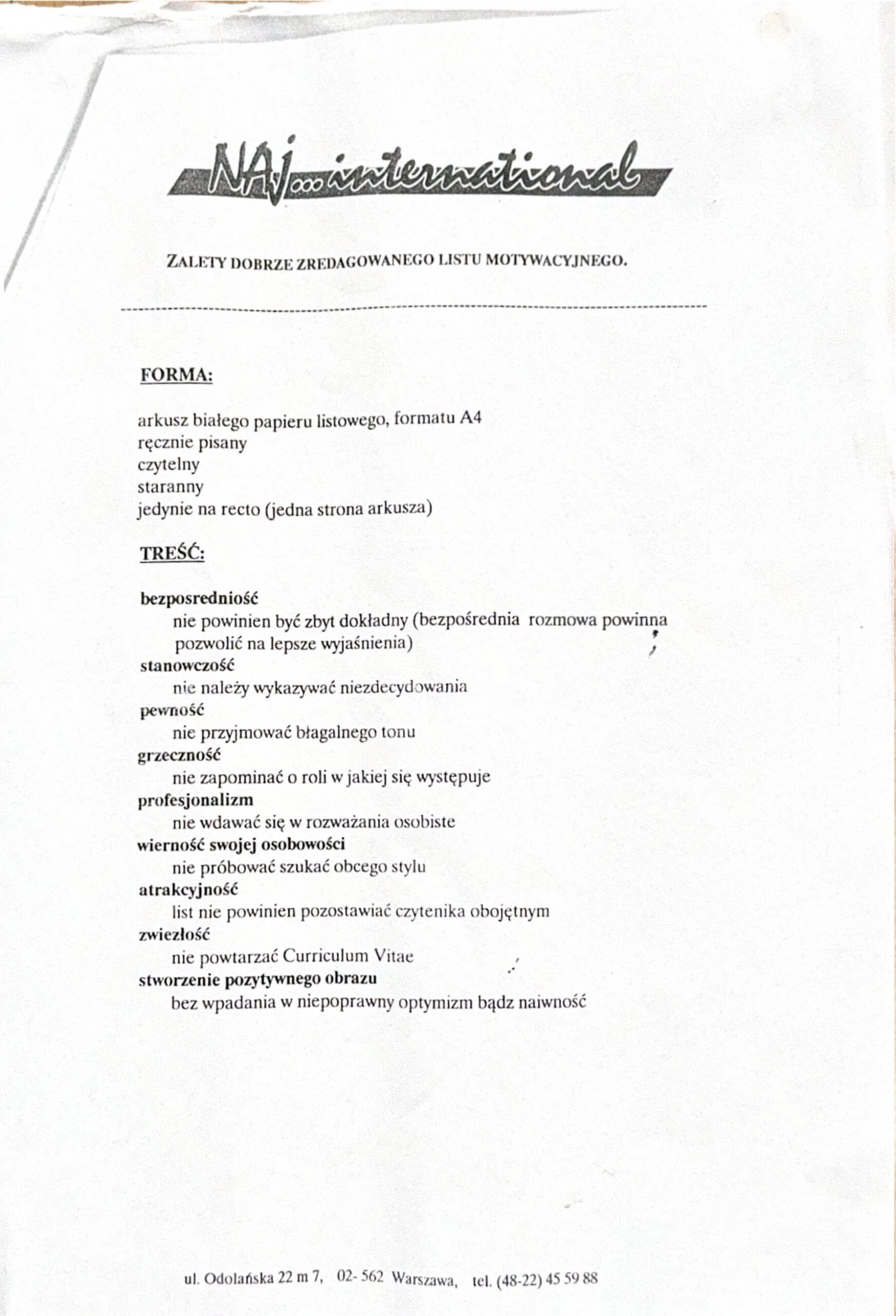
In the past, the content was not the only thing that mattered. The care taken in preparing the entire document was also important. The page layout, form of address and signature indicated whether the candidate understood the principles of professional communication.
The archival NAJ template did not encourage unsupported self-praise. Instead, it recommended describing the candidate’s career idea and the specific benefits they could bring to the department and the company.
Candidates were not expected merely to explain who they were. They had to show why the company should invite them to a meeting.
During the early years of the executive search market, access to information was limited. There were no professional profiles updated in real time, no portfolios available through a single link and no range of digital communication channels.
One document therefore performed the role now divided among a CV, LinkedIn profile, message to a consultant and initial interview.
How did the internet change application documents?
The internet made applications easier to send, but it also reduced the value of many letters. Once a document could be copied, the company name changed and the same text sent many times, a personal declaration quickly became a standard attachment.
Ready-made templates appeared. With them came sentences about dynamic environments, new challenges and the ability to work both independently and as part of a team.
Candidates began to sound remarkably similar, although each of them claimed to be unique.
At the same time, professional CVs became more specific. They started to show achievements, the scale of responsibility and measurable results. It is therefore worth reviewing the guide to writing a professional CV at different career levels: Professional CV for Different Career Stages
The more information a well-prepared professional profile provides, the less reason there is to repeat the same points in an additional document.
What did LinkedIn and AI do to application letters?
LinkedIn moved career stories into the public space, while AI now helps us create many types of text. Today, a candidate can generate a polished statement tailored to a job advertisement within minutes.
The problem is that the recruiter also knows how easily it can be produced.
This does not mean that AI tools are useless. They can help organise arguments, shorten the text and remove awkward wording. However, they should not invent someone’s motivation.
When it is still unclear why a candidate wants a particular role after reading the document, technical correctness cannot save it.
For senior executives, the consistency of the full career narrative now matters more. A CV, professional profile, interview style and reasons for making a change should all tell the same story.
The guide on how to write an effective C-level executive CV may also be helpful: How to Write an Effective C-Level Manager CV
Recruiting for a key position?
When does such a document still make sense?
An additional text is useful when it explains a decision that cannot be understood from the employment history alone. It may concern a change of industry, a return to the job market, relocation or a move from a corporation to a family-owned company.
Sometimes it also helps explain the conscious decision to accept a position with a smaller scope of responsibility. On a CV, this may look like a step backwards. In reality, it can be a move towards a better fit, greater influence or a different model of professional life.
In such situations, a cover letter should not read like a school essay. Three elements are enough. First, the candidate should explain why the role is of interest. Next, they should connect their experience with the company’s challenge. Finally, they should show why the change is logical at this particular moment.
A short, personalised message to a consultant can also work well. Sometimes four specific sentences are more convincing than a full page of carefully polished declarations.
Authenticity does not mean writing without preparation. It means using arguments that could not be sent unchanged to any company.
Summary
A cover letter can still be useful, but only as a source of specific information. It may take the form of a message to a consultant, sent by email or through another communication channel. When it is sincere and meaningful, it has a chance to attract the recipient’s attention.
Most importantly, it should answer three questions: why this candidate, why this organisation and why now? It must sound like the voice of a person who understands their own career decision.
Is it worth writing one? Yes, in justified situations, preferably as a direct message addressed to a specific person.
Assessing C-Level Leadership Qualifications
The competencies of a C-level manager include both strong professional skills and an awareness of their strengths, which requires a thorough self-assessment. Understanding your key skills is essential to creating an effective CV and planning your professional development. It is worth considering how to precisely identify those competencies that will not only impress recruiters but also align with the demands of the new position and future career challenges.
Why is Qualification Assessment Important?
Qualification assessment is a key step in conscious career management. It helps you better understand your strengths and determine which competencies have the greatest impact on your professional success. For leaders at the managerial and C-level, both technical and leadership skills are important. However, in different professional situations, different managerial competencies may gain significance.
How to Identify Your Strengths?
Effective identification of strengths and competencies requires the use of modern self-assessment tools. Contemporary technologies, such as personality tests and competency analyses, allow for an accurate assessment of talents, work styles, and professional motivations. These tools help understand which skills are crucial for career development.
Self-Assessment Tools. Competencies of a C-level Manager.
Here are some popular tools for assessing qualifications and self-evaluation that can help precisely identify strengths and managerial skills:
- CliftonStrengths (Gallup StrengthsFinder) – Gallup’s test identifies 34 key talents, helping to understand where you achieve the best results. Key talents include, among others, “Analytical Abilities,” “Relationship Building,” and “Leadership.” The basic version allows for the identification of the top five talents, but for a fuller picture, especially after the age of 24, it is worth taking the full version of the test.
- DISC D3 Analysis – The DISC D3 tool examines behavior styles such as Dominance, Influence, Steadiness, and Conscientiousness. It also considers motivations and values, which help better understand communication and management styles. At Naj International, we successfully use DISC D3 analysis in the recruitment process for high managerial positions, which is appreciated by both clients and candidates.
- 360-degree Assessment – A method of gathering feedback from colleagues, supervisors, and subordinates that allows for a comprehensive evaluation of competencies. Particularly useful for leaders, this method helps identify strengths and weaknesses, providing a fuller picture of leadership skills and areas requiring development.
- Hogan Assessments – Hogan tests focus on key personality traits in a professional environment, such as ambition, emotional stability, and motivation. They can help understand management style, team leadership predispositions, and coping with stress, which is particularly important for individuals in leadership positions.
How to Use Self-Assessment Results?
Tailoring Your CV to Test Results
After conducting a self-assessment, it is worth incorporating its results into your CV. You can use them in three key sections.
1. “Professional Summary” Section (“Professional Profile”)
In this section, you can briefly present how your talents, strengths, and professional competencies contribute to your career successes. Self-assessment results can help formulate more precise and convincing descriptions of your skills, which are crucial for further career development.
- Gallup CliftonStrengths: If the test revealed the talent “Strategist,” highlighting your ability to anticipate future challenges and create effective plans, you can phrase it as follows:
‘Experienced and results-oriented Chief Operating Officer with 15 years of international experience in managing operations and implementing strategic technology solutions. Effectively anticipates future market challenges by developing and implementing action plans to increase operational efficiency and profitability in organisations in European and US markets.’ - DISC D3: If the DISC analysis indicated the “Influence” style, emphasizing your ability to build relationships and inspire a team, as well as “Conscientiousness,” related to organization and precision, you could present it like this:
‘Leader effective in building relationships and inspiring teams, while being well-organized and precise in task execution.”‘Team leader with 12 years of experience in international project management. Effective at building relationships and inspiring teams to achieve their goals. Precise in organising work and delivering projects to the highest quality standards, resulting in a 20% increase in productivity over the last three years.’
2. “Professional Experience” Section
In this section, you can highlight your professional achievements in the context of personality tests and self-assessment results. These results can help organize the description of achievements and effectively present your key skills. Well-described professional competencies can significantly enhance the attractiveness of your CV in the eyes of recruiters.
- CliftonStrengths: If the test indicated talents such as “Analytical Abilities” and “Arranger,” you could express it this way:
“Optimized business processes, contributing to a 15% increase in company savings.” - DISC D3: If the DISC analysis result indicated the “Dominance” style, characterized by making quick and key operational decisions, you could present it like this:
“Managed a team of 50 people, leading to a 15% increase in efficiency.”
3. Strengthening the Soft Skills Section
Soft skills, though harder to prove, are just as important as hard competencies. The results of psychometric tests, such as Hogan or DISC, can help in the precise description of these skills in the CV.
- Hogan Assessments: If the test results indicate your ability to manage stress and make effective decisions in difficult situations, this competency could be described as:
“Managed a team during a crisis, resulting in a 15% increase in efficiency.” - DISC D3: If the test indicated the “Steadiness” style, related to creating a stable work environment and high team retention, it can be phrased like this:
“Maintained team retention at 95% over two years, ensuring operational stability and employee satisfaction.”
All these examples allow for effective use of personality test results in creating a professional CV tailored to the job position. A precise description of skills and achievements will make your CV more credible and attractive to recruiters, highlighting your value as a leader.
Key Skills at the Managerial Level
It is important to understand that at different stages of a career, different skills and experiences gain importance. At the C-level, three main managerial skills are particularly important:
- Leadership and Team Management – At the C-level, the ability to effectively manage a team is essential. It is worth emphasizing experience related to leading teams, introducing new organizational structures, or managing change.
- Strategic Planning – This is a skill that often determines the effectiveness of a leader. C-level recruiters expect candidates to have the ability to think long-term, identify key business goals, and develop strategies for achieving them.
- Risk Management – In a rapidly changing business environment, the ability to anticipate threats and manage risk effectively is invaluable. It is worth highlighting experience related to identifying potential risks and taking appropriate preventive actions.
Conclusion
Career management at the C-level requires a deep understanding of your strengths and the conscious use of them in the recruitment process. Tools like CliftonStrengths, DISC D3, and Hogan Assessments allow for the precise identification of talents and provide valuable insights that can be effectively used in creating a tailored CV and in the recruitment process. It is important to always adapt your CV to the specifics of the position you are applying for. These tests not only help you assess whether the position matches your skills but also enable a better understanding of the value you bring to the organization, making it easier to effectively present key competencies. Consulting the results of these tests with HR experts or coaches can help optimally adjust your competencies to the demands of the modern job market.
Ewa Borek
The executive search firms ranking 2026 shows more than the names of leading recruitment firms. For boards, owners and C-level leaders, it is a signal that executive search is moving from transactional hiring toward strategic advice, talent intelligence and AI-supported market insight.
Hunt Scanlon reports that executive recruiters entered 2026 from a position of strength, with the sector growing by 11 percent. At the same time, clients expect search partners to shape leadership decisions earlier, not only execute searches once a vacancy is already open.
What the executive search firms ranking 2026 shows
The 2026 ranking shows that scale, consultant depth and international reach still matter. However, they are no longer enough on their own. For international employers, the more important question is whether a search partner can combine global standards with credible local execution.
This is why networks such as IESF are important in international executive search. They give clients access to experienced local partners in multiple markets, while keeping the process coordinated, discreet and aligned with business goals.
However, a ranking should not be read as a simple buying recommendation. It is a useful map of the market, but it does not answer every question a board must ask. For example, it does not automatically show whether a firm knows a specific country, sector, salary reality or candidate culture.
Therefore, the best use of a ranking is comparative. It helps leaders understand which organisations are visible globally. Then it should lead to deeper due diligence: methodology, consultant seniority, references, confidentiality, reporting and local execution.
Why growth does not make partner selection easier
A growing market gives clients more choice, but it also makes the buying decision more complex. Hunt Scanlon reports that the executive search sector expanded strongly and that many firms recorded positive growth. In practice, this means more providers are competing for attention, more firms are repositioning themselves and more messages sound similar.
For a C-level buyer, the risk is not lack of options. The risk is choosing a partner whose brand, process or network does not match the real business challenge. A search for a regional CFO, Plant Manager or Country Manager in Poland requires different strengths than a global board advisory project.
As a result, leaders should not ask only “Who is ranked highest?”. A better question is: “Which partner can reduce the risk of this specific leadership decision in this market?”. That shift changes the conversation from visibility to suitability.
In this context, the executive search firms ranking 2026 should be treated as a decision-support tool. It helps narrow the field, but it does not replace direct assessment of the people who will run the search.
How AI and talent intelligence are changing executive search
AI is changing executive search, but it does not replace judgement, trust or market relationships. Hunt Scanlon describes a shift away from transactional models toward talent intelligence, AI integration and earlier influence in leadership decisions. This is one of the most important leadership hiring trends 2026.
AI can accelerate research, but it can also make weak conclusions look certain. In executive search, the consultant’s role is to verify the market, question the data and protect the board from decisions that look logical in a system but fail in real business conditions.
Talent intelligence can help search firms map candidate pools, analyse market movement and compare leadership profiles across countries. Moreover, AI-supported tools can improve speed and structure. Still, executive search remains a human advisory process because senior candidates rarely move only because they appear in a database.
The real value comes from combining data with consultant judgement. A strong partner can explain what the market data means, which candidates are realistic and where the offer may need adjustment. In other words, technology can accelerate research, but it cannot take responsibility for the final recommendation.
What C-level leaders should check before choosing a search firm
A ranking is a starting point, but due diligence should decide the final shortlist. Before choosing an executive search partner, boards and owners should test whether the firm can work with the real complexity of the assignment. They should not rely only on a convincing brand story.
Key questions include:
- Relevant sector experience: Has the firm completed similar leadership searches in your industry?
- Country knowledge: Can the consultants explain local salary expectations, notice periods and candidate behaviour?
- Consultant seniority: Who will actually lead the project and speak with senior candidates?
- Search methodology: How will the market be mapped, approached, assessed and reported?
- Confidentiality: How will the firm protect sensitive business information and candidate data?
- Evidence of results: Can the partner show references, case studies or a relevant track record?
For many companies, the best executive search firms are not simply the largest ones. Instead, they are the firms that combine reach, judgement, discipline and market-specific experience.
Why IESF strengthens international executive search in Poland and CEE
International reach must be matched with local expertise when the search concerns Poland or CEE. A global network is valuable when a company compares talent across markets. However, hiring a senior leader in Poland also requires knowledge of local business culture, compensation levels, notice periods and candidate motivation.
IESF gives international clients access to executive search partners who understand their local markets and cooperate across borders. This model is especially useful when a company needs consistency in process, but also expects market-specific advice in each country.
This is important for foreign companies entering Poland. A headquarters team may know the target profile, but it may not know how Polish executives evaluate risk, employer credibility, decision speed or relocation. Therefore, a local executive search partner should act as a translator between global expectations and market reality.
Used well, the executive search firms ranking 2026 can help international companies identify global players and networks. However, the final partner should also understand the local leadership market in detail.
For international employers, the IESF model is useful because it combines cross-border coordination with local accountability. More context on this cooperation model is available in International recruitment IESF.
How NAJ International supports international leadership searches
NAJ International supports foreign companies by combining Polish market knowledge with access to the IESF international network. This matters when a client needs both local execution and cross-border coordination.
As the exclusive IESF partner in Poland, NAJ International helps companies identify senior leaders, board-level candidates and key managers in Poland. The work includes market mapping, candidate approach, role calibration, assessment support and advisory input during the search.
For international employers, this combination is practical. IESF provides access to trusted executive search partners across countries, while NAJ International brings the local knowledge needed to run a senior search in Poland with accuracy, discretion and business context.
This approach is especially useful for international employers entering Poland, building a leadership team or replacing a senior manager confidentially. In these situations, the international executive search partner must understand not only the job description, but also the business risk behind the appointment.
For companies planning senior appointments in Poland, the service page Executive Search in Poland explains how NAJ structures leadership searches, market mapping and candidate assessment.
If you need evidence of work across sectors, see Executive Search References Poland, where NAJ presents selected client references and cooperation examples.
Summary
The 2026 ranking is useful because it shows how the market is changing, not only which firms are visible.
Growth, AI and talent intelligence are making executive search more strategic. However, they also make partner selection more demanding.
If you are planning a senior leadership search in Poland or CEE, use the ranking as a market map. Then test each potential partner against the role, sector, country, confidentiality level and business risk. NAJ International, as the exclusive IESF partner in Poland, can help you turn that comparison into a practical search strategy.
Planning a senior leadership hire in Poland or CEE?
Frequently Asked Questions
What does the 2026 executive search ranking show?
The ranking shows which global search firms and networks are visible in the executive search market. It also reflects broader market changes, including growth, AI adoption and stronger demand for leadership advisory.
Is the largest executive search firm always the best choice?
Not always. Large firms may offer global reach, but the best partner depends on sector expertise, consultant seniority, local knowledge and the specific risk behind the hire.IESF connects experienced executive search partners across markets. This helps international clients combine cross-border coordination with local knowledge in each country.
Why is IESF relevant for international executive search?
IESF connects experienced executive search partners across markets. This helps international clients combine cross-border coordination with local knowledge in each country.
Why should foreign companies work with a local partner in Poland?
A local partner understands salary expectations, notice periods, candidate behaviour, business culture and regional talent pools. This helps foreign companies make more realistic and safer hiring decisions.
Key challenges for CEOs in Poland in 2026 revolve around five connected areas: profitability, growth, AI, talent, and risk.
For leadership teams, these are no longer separate topics. They now shape one operating agenda.
Polish CEOs are trying to protect margins while still building room for expansion. At the same time, they are making decisions under stronger market, technology, and geopolitical pressure than a year ago. The latest NAJ/IESF findings for Poland show that the top priorities include cost management and profitability, market expansion, digital transformation and AI, talent acquisition and retention, and geopolitical and economic risk management.
Why the key challenges for CEOs in Poland in 2026 are different
The biggest shift is that strategy and execution now move together.
A CEO can no longer separate financial performance from technology, people, and resilience.
Until recently, many companies could transform in stages. First, they optimized costs. Then, they pushed commercial growth. Only later did they modernize operations and management systems. Today, that sequence is harder to maintain.
The Polish CEO dataset shows a clear balance between financial discipline and growth ambitions. On one side, cost management and profitability remain the most frequently mentioned strategic priority. On the other, market expansion, AI, and talent are also high on the list.
That changes the nature of leadership. A CEO is no longer managing only the budget or only the strategy. Instead, the role is about managing the company’s ability to execute under constant pressure and changing conditions.
Therefore, any serious discussion about the CEO agenda in Poland in 2026 should start with sequencing. Not every challenge must be solved at once. However, leadership teams need to know which issue is slowing growth or weakening performance right now.
Which priorities dominate executive decision-making
Margin protection, growth, and execution capacity are now at the center of the CEO agenda.
AI is becoming a management tool, not just a technology initiative.
In the Polish research sample, the highest-ranked priorities were cost management and profitability, market expansion and international growth, digital transformation and AI, talent acquisition and retention, and geopolitical and economic risk management. This is a pragmatic structure. It suggests that CEOs are not looking for fashionable concepts. They are looking for control, visibility, and sustainable growth.
In practice, the agenda often looks like this:
- Profitability: the company must protect margins, simplify operations, and control fixed costs.
- Growth: the organization wants to enter new markets or grow its share in existing ones.
AI and digital capability: leadership expects better productivity, stronger data quality, and faster decisions. - Talent: without strong leaders in critical roles, strategy does not translate into execution.
- Risk: the business must respond to regulatory shifts, economic uncertainty, and supply chain exposure.
That is why key challenges for CEOs in Poland in 2026 cannot be reduced to one issue. In reality, executives must balance several tensions at the same time. They need to save and invest, accelerate and reduce risk, adopt AI and keep teams engaged.
Sector differences also matter. In manufacturing, operational efficiency, supply chain stability, and margin protection are especially visible. In technology and IT, scaling, innovation, and access to critical capabilities take on greater weight. In service sectors, customer experience, process efficiency, and team quality often become more important.
Where companies lose execution speed most often
The problem is rarely the strategy itself. More often, the breakdown happens between board-level decisions and organizational action.
The first barrier is a mismatch between ambition and capacity. Leadership teams plan growth, but the business still lacks the people, processes, or data needed to sustain it. As a result, the strategy looks convincing in presentations but weaker in operations.
The second obstacle is leadership depth. When the right leaders are missing, even a strong strategy loses momentum. This is especially true for roles that combine commercial responsibility, operational ownership, and change leadership. That helps explain why talent acquisition and retention remain so high on the Polish CEO agenda.
A third source of delay is an overloaded transformation portfolio. Companies launch multiple initiatives in parallel, yet they do not assign one clear owner for the outcome. In that situation, each function may perform reasonably well on its own terms, but the business still fails to move at the right speed.
A fourth trap appears around AI adoption. Some organizations invest in tools, but they do not change how decisions are made. Technology alone will not create momentum if managers still work with fragmented data, unclear accountability, and inconsistent KPIs.
That is why leadership teams should return to a few simple questions. Which roles are critical to execution? Where is margin erosion actually happening? Which decisions will have the greatest impact over the next quarter? Only then does transformation become operational rather than symbolic.
What CEOs should do in the next 90 days
The strongest companies do not try to fix everything at once. They start with a few decisions that unlock execution. A practical 90-day plan usually includes four steps.
Set one shared priority for the leadership team
First, the board should define one core outcome for the quarter. It may be margin recovery, sales growth, implementation speed, or stabilization of a critical function. What matters is that the leadership team understands that priority in exactly the same way.
Map the roles that are critical to strategy execution
Next, the company should identify which roles truly hold the business together. In one case, that may be the COO. In another, it may be a Plant Manager, CFO, or transformation leader. Without this map, it is difficult to make talent decisions that support delivery.
Separate what is important from what is merely urgent
The next step is to reduce the number of parallel initiatives. If everything is strategic, nothing is truly strategic. Therefore, companies need to focus on the projects that directly affect performance or resilience.
Build a simple decision and risk review rhythm
Finally, the organization needs a short and regular management rhythm based on data. This matters even more when cost pressure and geopolitical exposure are rising. In practice, key challenges for CEOs in Poland in 2026 demand fewer declarations and more clarity around decisions, owners, and deadlines.
In 2026, the biggest challenge for CEOs in Poland is not choosing between profitability, growth, technology, or talent. It is leading all four at the same time without losing execution speed.
Want to better understand which roles and decisions will matter most for strategy execution in 2026?
NAJ supports companies in assessing leadership priorities, mapping the market, and planning critical hires. This article is primarily meant to help structure the topic and show where execution risks most often emerge today.
Does delivering your strategy depend on filling a critical leadership role?
Frequently Asked Questions
What matters most for CEOs in Poland today?
The central task is to balance performance with the company’s ability to keep growing. In other words, businesses need to protect margins, invest selectively, and strengthen leadership capacity at the same time.
Is AI already a board-level priority?
Yes. AI is increasingly treated as part of productivity, decision quality, and operating control rather than as a standalone IT topic. The Polish CEO data also confirms its growing importance.
Why is talent still such a high priority?
Because strategy slows down without the right leaders in place. A company may have capital, demand, and a strong plan, but without capable people in critical roles, execution weakens.
Which risks should boards monitor most closely?
In most cases, the answer is a mix of cost pressure, regulation, geopolitical uncertainty, and operational exposure. The goal is not only to identify risks, but also to build the ability to respond quickly.
Sources
-
Poland – Country Highlights 2026, NAJ/IESF, base: 56 CEO interviews.
Confidential hiring in Poland matters whenever a visible recruitment process could damage your business plan, create internal disruption, or leak competitive intelligence.
In practice, confidentiality protects three things: your strategy, your current leaders, and the candidates you want to attract.
What “confidential hiring in Poland” means in practice
Confidential hiring in Poland is not “no information at all.” It is controlled disclosure, designed to protect your business while keeping candidates engaged.
That usually means the role is described without naming the company (or the exact unit/location), the shortlist is shared only with named stakeholders, candidates are contacted directly (no public ads), and sensitive documents are shared later – typically under an NDA.
For international employers, confidential hiring in Poland can also support quiet market entry, before competitors and media connect the dots.
Why confidentiality is a competitive advantage in the Polish market
Poland is an attractive talent market, but leadership hiring is competitive. The best candidates are often employed and risk-aware, and they respond faster when they see professional process control.
When confidentiality is handled well, you attract stronger passive candidates, reduce internal noise and retention risk, protect your market entry or transformation timeline, and prevent competitors from reading your next move.
It improves access to passive candidates
Senior leaders rarely apply to visible ads. They engage when the process is discreet, structured, and clearly aligned with data protection expectations.
It protects strategy and stakeholder trust
Confidentiality reduces speculation and helps you control timing. This is especially important for market entry, sensitive transformations, and leadership changes.
Confidential hiring in Poland helps you protect:
- Strategic intent (market entry, product moves, investment plans)
- Business continuity (leadership transitions, turnarounds, restructurings)
- Candidate privacy and engagement (especially among passive executives)
Confidential hiring in Poland: 7 common scenarios
Confidential hiring in Poland is most critical when recruitment visibility creates operational, reputational, or competitive risk. Below are seven scenarios where discretion directly protects outcomes.
In each case, the goal is not “silence.” The goal is a controlled process that limits leakage, keeps stakeholders aligned, and maintains candidate trust.
1) Replacing a current leader
If you are replacing a CEO, CFO, Plant Director, or Country Manager, discretion is essential. A visible process can trigger panic, political behaviour, and early departures. What to protect: timeline, stakeholder narrative, and business continuity.
Replacing a senior leader is one of the most sensitive moments in an organisation. In Poland, confidentiality in executive recruitment is not just good practice – it is risk management. NDAs, staged information release, and strict stakeholder access reduce internal noise, protect business continuity, and safeguard sensitive business information throughout the search.
2) Market entry or launching a Polish entity
When you are entering Poland, hiring is an early market signal. Competitors can infer your target customers, location strategy, product plans, and investment size. Confidential hiring in Poland lets you build leadership capacity before the market reacts.
3) Restructuring, turnaround, or crisis recovery
During restructuring, rumours spread fast. A visible search can intensify fear inside the organisation, supplier uncertainty, and client hesitation. Confidential hiring in Poland helps you fill critical roles without adding pressure to an already sensitive situation.
4) Building a new function before you announce it
Examples include strengthening compliance, cybersecurity leadership, or M&A capability. Early exposure can create unwanted attention from regulators, competitors, or other stakeholders. Confidential hiring in Poland protects strategic intent and readiness.
5) Roles involving sensitive information
This includes leadership positions connected to finance and cash strategy, cybersecurity and incident response, pricing and procurement, or strategic planning. In these searches, confidentiality is not a “nice to have.” It is risk control.
6) Competitive poaching and talent wars
If competitors learn you are hiring for a key role, they may counter-offer your target candidate, approach your current leaders, or launch a defensive hiring campaign. A discreet approach reduces the chance that your recruitment becomes market news.
7) Preventing a domino effect inside the organisation
Even if you are not replacing someone directly, visible hiring for a senior role can trigger assumptions about reorganisation, shifting budgets, or loss of influence. That can lead to unnecessary turnover. Confidential hiring in Poland helps you control the internal message and timing.
How an Executive Search partner keeps the process discreet
Confidential hiring in Poland works best when discretion is supported by repeatable procedures—not informal caution. A strong Executive Search partner builds confidentiality into the process from the start.
The goal is to protect sensitive information while keeping the search efficient, candidate-friendly, and compliant with data handling expectations. If you want to review how we approach sensitive projects, see our AI policy for executive search and related confidentiality principles.
NDAs and staged disclosure
At the start, an NDA defines what can be shared, with whom, and at what stage. For highly sensitive searches, candidates may also sign a confidentiality letter before receiving identifying details. Confidentiality is strongest when it is planned, not improvised.
Direct outreach instead of public exposure
For leadership roles, direct search limits information leakage and reaches passive candidates who avoid visible job moves. This is why confidential hiring in Poland is often delivered through Executive Search rather than open advertising.
Tight stakeholder access and “need-to-know” rules
Leaks often happen when too many people have uncontrolled access. A disciplined process limits the stakeholder group, defines one communication channel, and sets rules for sharing materials and feedback.
Candidate experience that signals professionalism
Senior candidates look for clear timelines, clear data handling, minimal exposure, and respectful communication. When candidates trust the process, they engage faster and stay engaged longer.
A short checklist for international employers
If confidentiality matters, set the rules before you start outreach. A short pre-alignment meeting with stakeholders often prevents most confidentiality risks later.
Use this checklist as a baseline for confidential hiring in Poland. If you are comparing providers and process models, you may also want to review our Executive Search in Poland FAQ.
Checklist for confidential hiring in Poland:
- Define the confidentiality level: anonymous client vs. named client from the start.
- Limit stakeholders: decide who sees what, and when.
- Create a “safe” role description: accurate, but not identifying.
- Agree on a communication rhythm: fewer touchpoints, higher quality.
- Plan disclosure milestones: NDA → company reveal → deeper materials.
- Protect internal narrative: define what you will say if rumours start.
- Decide on background checks timing: late enough to avoid leakage, early enough to manage risk.
Planning a confidential executive search in Poland?
Closing: when discretion protects results
If your role relates to leadership change, market entry, restructuring, or sensitive information, confidential hiring in Poland should be the default. It protects your strategy, reduces internal disruption, and improves candidate response. With the right process discipline, confidentiality does not slow the search. It often makes decisions faster and cleaner.
Frequently Asked Questions
Is confidential hiring in Poland legal and compliant?
Yes. Confidential recruitment can be conducted in Poland, provided that candidate personal data is processed in line with GDPR requirements and access to sensitive information is properly controlled. Confidentiality does not replace data protection obligations – it defines how sensitive business information is shared during the process.
When should we reveal the company name to candidates?
There is no single disclosure point for every search. In sensitive projects, the company may remain anonymous during the initial approach and be revealed at an agreed stage, sometimes after an NDA has been signed. The key is staged disclosure: candidates receive the information they need at the right moment, without exposing sensitive business context too early.
Does confidentiality slow down recruitment?
No, if the process is designed properly. Clear disclosure rules, limited stakeholder access and an agreed communication process can make decisions faster by reducing uncertainty and unnecessary information flow. Confidentiality becomes a source of delay mainly when these rules are not defined at the start.
What is the biggest confidentiality risk in practice?
The biggest risk is usually uncontrolled access to information. Too many stakeholders forwarded candidate profiles, inconsistent communication or premature disclosure of the business context can expose a sensitive search. Clear access rules and a defined communication process help keep the information under control.
5 Key Trends in Hiring C-Level Executives in 2025. How to Prepare for the Future.
Learn about the key trends in C-level Executives recruitment that will dominate 2025. See how globalization, digital transformation, and ESG will shape the future of leadership.
Introduction
Key trends in C-level recruitment for 2025 will determine the future of top-level management. Leaders must prepare for dynamic changes in the global business environment. Globalization, digital transformation, sustainability, and technological innovation will become key factors influencing the requirements for top management. These trends will shape the future of recruitment for senior positions, and we, as part of the global IESF recruitment network, have a unique opportunity to analyze these changes. In this article, I describe the most important trends that will dominate the C-level recruitment processes in the coming years, based on the latest reports, such as The Future of Work or Hunt Scanlon, and other industry sources (you will find the full list at the end of the article).
Understanding upcoming trends will not only help you, as a leader, prepare for future challenges but also present your competencies in a way that is crucial for effectively managing your C-level career. Learn how to write an effective C-level manager CV to better showcase your skills and experience.
1. Globalization and Remote Management in 2025. How to Prepare for the Future?
More and more companies are operating in a global environment, where skills related to managing teams dispersed worldwide are becoming essential. Leaders must effectively communicate across diverse cultures and time zones, emphasizing the importance of managing remote teams. In the coming years, C-level recruitment will focus on leaders who can effectively operate in such global structures and implement strategies tailored to different markets.
In 2024, remote and hybrid work became the standard in many organizations. Research from The Future of Work indicates that 81% of companies plan to maintain remote work options for their employees, underscoring the importance of management skills in these work models.
- According to the Future of Work report, flexible work models will continue to gain importance, and leaders who can effectively manage distributed teams will become a key asset for companies in the age of globalization and digitization.
Recommendation for C-level Executives:
Supporting international structures and integrating tools that facilitate remote collaboration will become a crucial task for future leaders. Managers should strive to improve competencies related to managing global teams and developing international operational strategies.
2. Digital Transformation and Technological Innovation for C-Level Executives. The Key to Competitive Advantage
Digital transformation and technological innovations will be critical to future business models. Growing customer expectations for access to digital products and services, as well as the need for process automation, will impact the operational efficiency of companies.
C-level leaders are responsible for implementing these changes, introducing new technologies such as artificial intelligence (AI), automation, and data analysis. This challenge requires a deep understanding of modern tools and their effective integration with existing structures.
- According to data from Hunt Scanlon, companies are looking for managers who can transform business models using technology to remain competitive in a dynamically changing environment.
- Industry reports indicate that technologies such as AI, Big Data, and automation will be key drivers of business transformation between 2023 and 2027.
Recommendation for C-level Executives:
Leaders should focus on implementing modern technologies that enable more efficient management of data and processes, allowing them to stay competitive in the market. It’s essential to develop digital competencies for both themselves and their teams.
3. Sustainability and ESG (Environmental, Social, Governance). A New Standard for Leaders
The growing importance of social responsibility and sustainability means that more and more companies expect C-level leaders to implement strategies based on ESG values. These values are becoming not only a regulatory requirement but also a key factor for competitiveness. Competence in this area is becoming a key recruitment factor, and social responsibility and pro-environmental actions are an integral part of corporate strategies.
- The Hunt Scanlon 2024 report emphasizes that leaders must have the ability to manage ESG initiatives, which are becoming not only a market requirement but also an element that strengthens a company’s competitive position.
- The EY report notes that 87% of C-level leaders consider ESG initiatives crucial for the long-term success of companies. As a result, C-level managers are increasingly being recruited based on their ability to manage sustainable development.
Recommendation for C-level Executives:
Introducing ESG strategies into organizations is an essential part of future leaders’ actions. Managers should skillfully introduce initiatives that support social responsibility and manage the company’s sustainable development.
4. Organizational Culture and Talent Management. Building a Strong Organization
Organizational culture and talent management are key elements that influence the success of companies. C-level leaders must not only retain the best employees but also attract new talent by creating a work environment conducive to diversity, inclusion, and employee well-being. Building teams based on company values and supporting their development is becoming crucial.
- According to data from the Corporate Culture Report 2024, leaders must skillfully shape organizational culture to attract and retain the best talent, which directly impacts financial results and stability.
- In light of changes in employment structures and the increasing importance of flexibility and diversity, companies must provide leaders with the tools to shape the right organizational culture.
Recommendation for C-level Executives:
Managers should focus on creating a strong organizational culture that fosters innovation, diversity, and team efficiency. Creating a talent-friendly environment will increase employee engagement and loyalty.
5. Artificial Intelligence in Recruitment. Optimizing C-Level Processes
One of the biggest trends in the coming years is the growing role of artificial intelligence (AI) in recruitment processes. AI will support recruiters by speeding up candidate selection, identifying talent, and helping to better match competencies to positions.
- Hunt Scanlon analysis shows that companies are increasingly investing in AI technologies that support the C-level recruitment process, enabling more precise candidate assessments and process optimization.
Recommendation for C-level Executives:
Leaders should consider implementing AI solutions and automating certain areas of the recruitment process, which will allow for more effective and optimized processes.
Conclusion
Key trends in C-level recruitment for 2025 will have a significant impact on the future of leadership. Globalization, digital transformation, ESG, and technological innovations require new competencies and flexibility from leaders. Companies must hire leaders who will not only meet these challenges but also help shape the future of their organizations.
Thanks to our unique resources and international collaboration with IESF, we are among the Top 40 best Executive Search companies in the world, giving us a unique perspective on the changing trends in top-level leadership recruitment.
Sources:
https://www.weforum.org/publications/the-future-of-jobs-report-2023/
https://huntscanlon.com/2024-state-of-the-industry-study-part-1/
https://huntscanlon.com/2024-culture-report/
https://kpmg.com/us/en/articles/2023/generative-artificial-intelligence-2023.html
https://www.ey.com/en_us/sustainability/sustainability-and-esg-trends-index
https://kpmg.com/us/en/articles/2023/generative-artificial-intelligence-2023.html
How to give yourself “career insurance” during uncertain times?
In a time of so much uncertainty, many professionals feel unmoored. We can’t control the public health situation or the broader economy. But when it comes to our careers, we don’t have to sit back and wait for things to happen to us. Here are four steps every professional can take now to create their own long-term career insurance. That will help protect them—regardless of broader instability:
Develop “bridging capital”
Most professionals, unless they’re making a conscious effort, tend to build homogeneous networks. That’s fine–until it isn’t. In a downturn, you need diversity—of industry, age, skills, and background. Now is the time to start consciously seeking out diverse networks. They provide the benefit of exposing you to new ideas and methodologies. In boom times play an even more critical role during contractions, when they can yield critical market intelligence or even job leads. After all, it doesn’t help you to know 1,000 people at your company or in your industry if everyone else has also been laid off.
For instance, an executive in the travel industry will be much more professionally nimble—and has a better chance of landing a new job quickly—if she’s taken the time to develop contacts who work in countercyclical fields, such as online streaming or shipping logistics. Tapping existing contacts with diverse circles is a good starting place to build your network. For instance, you could host a virtual networking dinner with a cohost, with each of you inviting half the guests, so your social networks can cross-pollinate. This is especially useful if your cohost doesn’t work in your company or industry. (For instance, you could tap a college friend, someone from your recreational sports league, or someone you met at the dog park.)
Step into volunteer leadership vacuums
Especially during a crisis, many professionals pull back on volunteer activities since they’re worried about their paid responsibilities- careers. That’s an opportunity for you because it’s also a time when many people seek out the solace of a community. Even if your previous involvement has been minimal, you can step up and offer to run a webinar, virtual “mixer,” or skills development workshop for a company Employee Resource Group or a professional association. It’s a chance to help others and build a positive reputation in the process.
Create intellectual property
Many professionals are respected by their peers who work with them directly. But it’s rare—and valuable—to gain the respect of those who have never worked with you directly on the strength of your ideas. These days, you may not have the opportunity to speak at many in-person conferences. But you can share your expertise online by creating written content, such as blogging about industry topics on LinkedIn or offering to write for your company’s newsletter.
One frequently overlooked opportunity is sharing ideas or best practices regularly on your company’s intranet. Busy professionals sometimes view this as a distraction, but because this is often the pet project of senior leaders who hope to break down organizational silos, it’s a chance to get noticed. One friend of mine ended up in an extended personal dialogue with her CEO after replying to an intranet thread about ideas for increasing environmental sustainability at the company. The key is making your insights known to people inside and outside your company, so they remember your name and can say, “I like the way she thinks.”
Test a side project
You may love working for your company and have no desire to start a side business. Do it anyway. In a rocky economy, the more optionality you have, the better, like Pat Flynn, whom I profile in my book Entrepreneurial You. Flynn was an employee at an architectural firm who started a blog to capture his study notes as he readied himself for a professional exam around green building practices. Eventually, he created an e-book based on his articles and sold it for a modest fee on his website.
That became a lifeline for him when, in 2008, he got laid off from his firm. But since he had created a side business that actually earned him more each month than his day job, he didn’t flounder. Start small, work for free at first, and test out possibilities to see what you enjoy and whether others seem interested. At a minimum, it’ll teach you new skills you can bring back to your job. And at best, it can bring in new income and perhaps open future professional doors.
In uncertain times, we have to ask ourselves: What assets would we most want to have in the case of a prolonged downturn? And what steps can we take to obtain them today? By seizing the initiative now, you’ll have created—in small, manageable ways—” career insurance” that will see you through, regardless of how your company or industry fares moving forward.
Dorie Clark is a marketing strategy consultant who teaches at Duke University’s Fuqua School of Business and has been named one of the Top 50 business thinkers in the world by Thinkers50. She is the author of Entrepreneurial You, Reinventing You, and Stand Out.
It can be also interesting for you Becoming CEO. 7 Tips.