
Assessing C-Level Leadership Qualifications
The competencies of a C-level manager include both strong professional skills and an awareness of their strengths, which requires a thorough self-assessment. Understanding your key skills is essential to creating an effective CV and planning your professional development. It is worth considering how to precisely identify those competencies that will not only impress recruiters but also align with the demands of the new position and future career challenges.
Why is Qualification Assessment Important?
Qualification assessment is a key step in conscious career management. It helps you better understand your strengths and determine which competencies have the greatest impact on your professional success. For leaders at the managerial and C-level, both technical and leadership skills are important. However, in different professional situations, different managerial competencies may gain significance.
How to Identify Your Strengths?
Effective identification of strengths and competencies requires the use of modern self-assessment tools. Contemporary technologies, such as personality tests and competency analyses, allow for an accurate assessment of talents, work styles, and professional motivations. These tools help understand which skills are crucial for career development.
Self-Assessment Tools. Competencies of a C-level Manager.
Here are some popular tools for assessing qualifications and self-evaluation that can help precisely identify strengths and managerial skills:
- CliftonStrengths (Gallup StrengthsFinder) – Gallup’s test identifies 34 key talents, helping to understand where you achieve the best results. Key talents include, among others, “Analytical Abilities,” “Relationship Building,” and “Leadership.” The basic version allows for the identification of the top five talents, but for a fuller picture, especially after the age of 24, it is worth taking the full version of the test.
- DISC D3 Analysis – The DISC D3 tool examines behavior styles such as Dominance, Influence, Steadiness, and Conscientiousness. It also considers motivations and values, which help better understand communication and management styles. At Naj International, we successfully use DISC D3 analysis in the recruitment process for high managerial positions, which is appreciated by both clients and candidates.
- 360-degree Assessment – A method of gathering feedback from colleagues, supervisors, and subordinates that allows for a comprehensive evaluation of competencies. Particularly useful for leaders, this method helps identify strengths and weaknesses, providing a fuller picture of leadership skills and areas requiring development.
- Hogan Assessments – Hogan tests focus on key personality traits in a professional environment, such as ambition, emotional stability, and motivation. They can help understand management style, team leadership predispositions, and coping with stress, which is particularly important for individuals in leadership positions.
How to Use Self-Assessment Results?
Tailoring Your CV to Test Results
After conducting a self-assessment, it is worth incorporating its results into your CV. You can use them in three key sections.
1. “Professional Summary” Section (“Professional Profile”)
In this section, you can briefly present how your talents, strengths, and professional competencies contribute to your career successes. Self-assessment results can help formulate more precise and convincing descriptions of your skills, which are crucial for further career development.
- Gallup CliftonStrengths: If the test revealed the talent “Strategist,” highlighting your ability to anticipate future challenges and create effective plans, you can phrase it as follows:
‘Experienced and results-oriented Chief Operating Officer with 15 years of international experience in managing operations and implementing strategic technology solutions. Effectively anticipates future market challenges by developing and implementing action plans to increase operational efficiency and profitability in organisations in European and US markets.’ - DISC D3: If the DISC analysis indicated the “Influence” style, emphasizing your ability to build relationships and inspire a team, as well as “Conscientiousness,” related to organization and precision, you could present it like this:
‘Leader effective in building relationships and inspiring teams, while being well-organized and precise in task execution.”‘Team leader with 12 years of experience in international project management. Effective at building relationships and inspiring teams to achieve their goals. Precise in organising work and delivering projects to the highest quality standards, resulting in a 20% increase in productivity over the last three years.’
2. “Professional Experience” Section
In this section, you can highlight your professional achievements in the context of personality tests and self-assessment results. These results can help organize the description of achievements and effectively present your key skills. Well-described professional competencies can significantly enhance the attractiveness of your CV in the eyes of recruiters.
- CliftonStrengths: If the test indicated talents such as “Analytical Abilities” and “Arranger,” you could express it this way:
“Optimized business processes, contributing to a 15% increase in company savings.” - DISC D3: If the DISC analysis result indicated the “Dominance” style, characterized by making quick and key operational decisions, you could present it like this:
“Managed a team of 50 people, leading to a 15% increase in efficiency.”
3. Strengthening the Soft Skills Section
Soft skills, though harder to prove, are just as important as hard competencies. The results of psychometric tests, such as Hogan or DISC, can help in the precise description of these skills in the CV.
- Hogan Assessments: If the test results indicate your ability to manage stress and make effective decisions in difficult situations, this competency could be described as:
“Managed a team during a crisis, resulting in a 15% increase in efficiency.” - DISC D3: If the test indicated the “Steadiness” style, related to creating a stable work environment and high team retention, it can be phrased like this:
“Maintained team retention at 95% over two years, ensuring operational stability and employee satisfaction.”
All these examples allow for effective use of personality test results in creating a professional CV tailored to the job position. A precise description of skills and achievements will make your CV more credible and attractive to recruiters, highlighting your value as a leader.
Key Skills at the Managerial Level
It is important to understand that at different stages of a career, different skills and experiences gain importance. At the C-level, three main managerial skills are particularly important:
- Leadership and Team Management – At the C-level, the ability to effectively manage a team is essential. It is worth emphasizing experience related to leading teams, introducing new organizational structures, or managing change.
- Strategic Planning – This is a skill that often determines the effectiveness of a leader. C-level recruiters expect candidates to have the ability to think long-term, identify key business goals, and develop strategies for achieving them.
- Risk Management – In a rapidly changing business environment, the ability to anticipate threats and manage risk effectively is invaluable. It is worth highlighting experience related to identifying potential risks and taking appropriate preventive actions.
Conclusion
Career management at the C-level requires a deep understanding of your strengths and the conscious use of them in the recruitment process. Tools like CliftonStrengths, DISC D3, and Hogan Assessments allow for the precise identification of talents and provide valuable insights that can be effectively used in creating a tailored CV and in the recruitment process. It is important to always adapt your CV to the specifics of the position you are applying for. These tests not only help you assess whether the position matches your skills but also enable a better understanding of the value you bring to the organization, making it easier to effectively present key competencies. Consulting the results of these tests with HR experts or coaches can help optimally adjust your competencies to the demands of the modern job market.
Ewa Borek
Choosing the best candidate for a key role is rarely a purely rational decision. Even when the shortlist is strong and the data looks clear, managers still need to balance structured evaluation with intuition.
Making hiring decisions is one of the biggest challenges every manager faces. Therefore, this article explains how to approach candidate selection more consciously, especially when several finalists are highly qualified and the role will have a long-term impact on the business.
Intuitive versus rational decisions
Hiring decisions are rarely based on facts alone. Even with competency tables, references and several interviews completed, emotions still influence how we assess each finalist.
Recently, I spent several days visiting flooring stores. With each passing day, I knew more about types of wood, durability, colours and installation methods. However, instead of making the decision easier, this knowledge made it harder.
Standing in front of a shelf full of samples, I wondered: “Will this choice really be the right one for years to come?”
Does this sound familiar? Similarly, do you feel the same when you need to make a decision with long-term consequences? Selecting the best candidate for a key position can evoke similar feelings, especially when all finalists are highly qualified.
That is why it is worth looking at the decision-making process and understanding the mechanisms that guide our choices. Psychologists, including Daniel Kahneman, have shown that many decisions are made intuitively, based on emotions and previous experience.
In practice, our brain works in two modes:
- System 1, fast and intuitive. This is our automatic reaction, based on instinct and past experience. It is quick, but it can be affected by cognitive biases, such as the halo effect. For example, a positive impression during an interview may influence how we assess a candidate’s competencies.
- System 2, slow and analytical. This is the process of conscious thinking, which requires time and effort. In this mode, we analyse data, compare arguments and try to make decisions logically.
When choosing a candidate, both systems work together. Still, emotions often tip the scales, for example when a client chooses the person they “clicked with” during the interview, even though another finalist may have slightly stronger qualifications.
Neuroscience in decision making
A hiring decision engages both analysis and emotion. That is why a list of requirements alone is not always enough to feel confident at the final stage.
Brain research shows that decision making involves several key areas. First, the prefrontal cortex is responsible for analytical thinking and for evaluating the long-term consequences of a decision. This is where information about candidates’ competencies is processed.
Second, the limbic system deals with emotions and intuition. As a result, choosing a candidate with whom the conversation felt natural may be linked to the activity of this area.
In addition, mirror neurons are activated when we see similarities between ourselves and another person. As a result, a candidate who shares similar values or a similar communication style may seem like a “natural choice”.
Interestingly, the more information we analyse, the higher the risk of decision paralysis. This is known as the paradox of choice. When we have too many options, it becomes harder to decide, and we become more concerned that we may choose incorrectly.
Selection criteria for the best candidate
The best protection against decision chaos is a clear set of criteria agreed in advance. This helps the final discussion focus not only on impressions, but also on comparable evidence.
To simplify the decision-making process, it is useful to work with analytical tools such as a candidate comparison table. In the case of an Operations Director role, finalists may be compared across several categories.
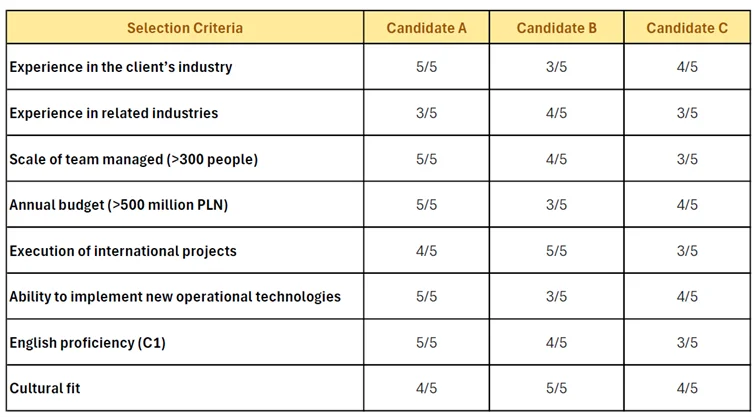
Comparing finalists against predefined criteria helps structure the decision and reduces the influence of interview impressions alone.
The criteria may include:
- Industry experience. Priority is given to professional experience in the client’s sector, for example energy, manufacturing or FMCG.
- Related sector experience. Knowledge of sectors adjacent to the client’s industry may bring valuable competencies and a broader perspective.
- Scale of team management. It is useful to compare the number of people directly and indirectly managed by the candidate. In large organisations, this may mean experience in managing teams of more than 300 people.
- Annual budget responsibility. Relevant experience may include responsibility for an operational budget that reflects the scale of the client’s organisation, for example at least PLN 500 million.
- International project execution. The number and scale of operational projects delivered across countries show whether the candidate can work effectively in a global environment.
- Implementation of new operational technologies. Experience in process optimisation and implementation of new tools may directly improve operational efficiency.
- English proficiency at C1 level. Fluent written and spoken business communication enables effective cooperation with international stakeholders.
- Cultural fit. Alignment between the candidate’s values, working style and the client’s organisational culture can be assessed through interviews, observations and structured criteria.
The criteria may include:
- Industry experience. Priority is given to professional experience in the client’s sector, for example energy, manufacturing or FMCG.
- Related sector experience. Knowledge of sectors adjacent to the client’s industry may bring valuable competencies and a broader perspective.
- Scale of team management. It is useful to compare the number of people directly and indirectly managed by the candidate. In large organisations, this may mean experience in managing teams of more than 300 people.
- Annual budget responsibility. Relevant experience may include responsibility for an operational budget that reflects the scale of the client’s organisation, for example at least PLN 500 million.
- International project execution. The number and scale of operational projects delivered across countries show whether the candidate can work effectively in a global environment.
- Implementation of new operational technologies. Experience in process optimisation and implementation of new tools may directly improve operational efficiency.
- English proficiency at C1 level. Fluent written and spoken business communication enables effective cooperation with international stakeholders.
- Cultural fit. Alignment between the candidate’s values, working style and the client’s organisational culture can be assessed through interviews, observations and structured criteria.
The outcome of the final decision
Making the final decision often brings relief, but it does not always remove all doubts. A client may still wonder whether another finalist would have performed better.
In such moments, it is worth remembering that the recruitment agency has already carried out a comprehensive selection process. Before presenting several finalists, it analysed dozens, and sometimes hundreds, of profiles.
Many clients make decisions partly based on emotions. They choose the person with whom the conversation went best or who made the strongest impression. However, this is not necessarily a wrong approach if all finalists have already been carefully assessed and matched to the role profile.
Moreover, recruitment agencies often offer a guarantee for the hired candidate, usually from 6 to 12 months. This provides additional security for the client and shows the agency’s commitment to the success of the hire.
Summary
Recruitment decisions require both analysis and intuition. Understanding how the brain works helps decision makers approach the final choice more calmly and responsibly.
As a result, structured tools, such as a candidate comparison table, help organise information and choose the person who best fits the organisation’s needs. At the same time, intuition still matters, because recruitment is about people, cooperation and trust.
Once the best candidate has been selected, it is worth trusting a well-managed process. Ultimately, the decision is not only about matching the job description, but also about finding a person who will work well with the team and support the company’s growth.
If you are facing a similar decision for a key role in Poland or CEE, it is worth discussing the assessment criteria, risks and process design before finalists reach the last interview stage.
Recruiting for a key leadership role?
Sources
-
Daniel Kahneman, Thinking, Fast and Slow.